
Primate Capital of the World: Why Uganda Has the Most Primates
Uganda has earned a rare ecological reputation as the “Primate Capital of the World,” and this title is not just tourism branding—it is rooted in biodiversity science. Nowhere else in Africa offers such a high concentration of primate species within relatively small, accessible protected areas.
From dense tropical forests to savannah woodlands and wetland edges, Uganda supports an exceptional range of primates including chimpanzees, colobus monkeys, baboons, mangabeys, and the iconic mountain gorillas.
This extraordinary diversity is anchored in key ecosystems such as Kibale Forest National Park, Bwindi Impenetrable National Park, and Queen Elizabeth National Park, which together form one of the richest primate corridors in Africa.
Understanding why Uganda holds this status requires looking at geography, forest structure, climate stability, and evolutionary history.
The Geography Behind Uganda’s Primate Diversity
Uganda sits at a unique ecological intersection between East African savannah ecosystems and Central African rainforests. This transitional positioning allows species from both ecological zones to coexist.
Western Uganda, in particular, lies within the Albertine Rift, a region of intense geological activity that created mountains, deep forests, and isolated habitats. These conditions encourage speciation, meaning primates evolve into distinct subspecies over time.
Forests such as Bwindi Impenetrable National Park and Kibale Forest National Park are ancient and stable, providing uninterrupted habitats that have existed for thousands of years. This long-term stability is critical for primate survival and diversification.
Kibale Forest: The Chimpanzee Stronghold
One of the most important primate ecosystems in Africa is Kibale Forest National Park, often referred to as the primate capital within the primate capital.
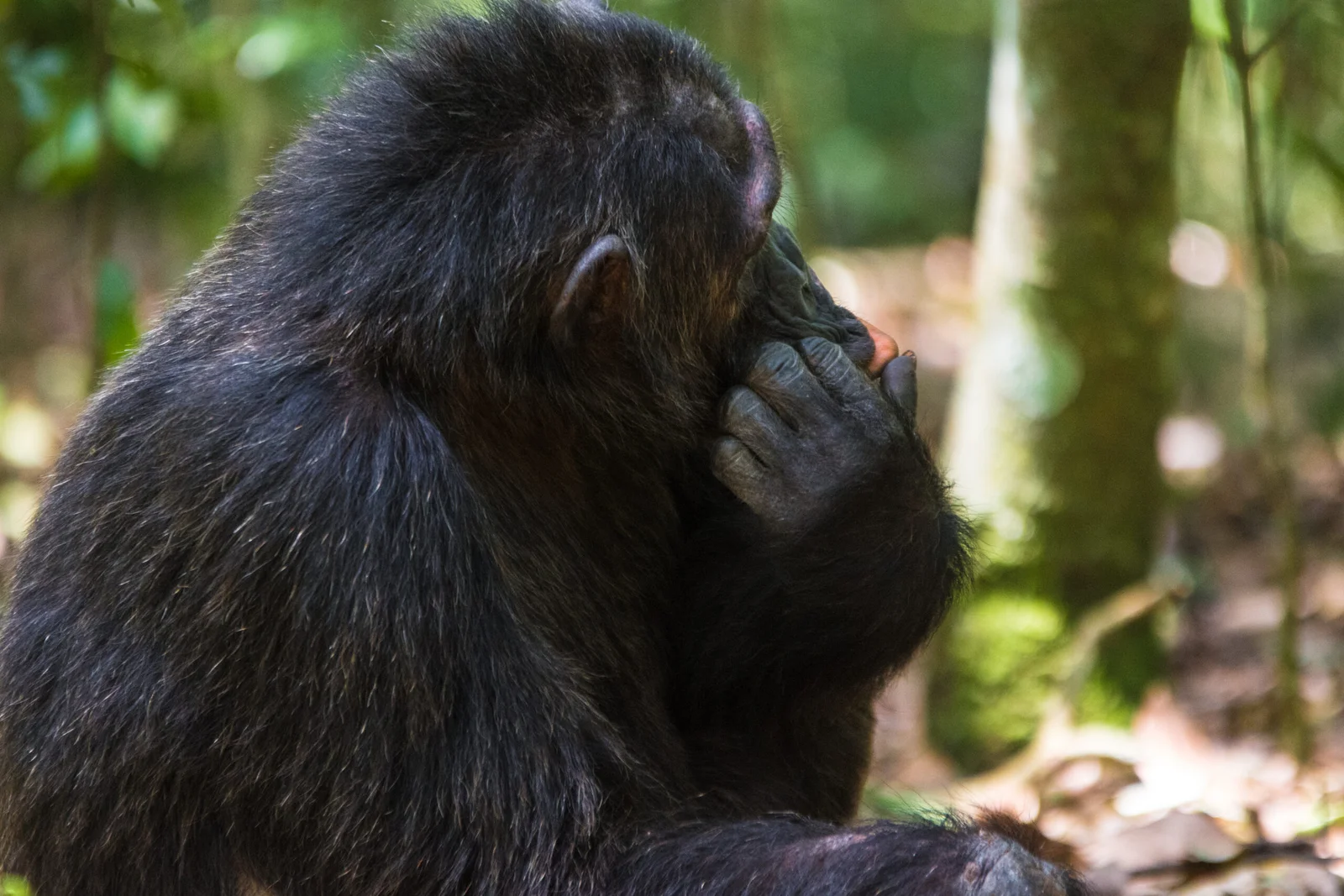
This forest alone hosts over a dozen primate species, including one of the largest populations of chimpanzees in East Africa. It is also home to red colobus monkeys, L’Hoest’s monkeys, blue monkeys, and grey-cheeked mangabeys.
Chimpanzee tracking in Kibale is one of Uganda’s most popular wildlife activities, offering high encounter success rates due to strong habituation programs.
The dense forest structure, mixed canopy layers, and abundant fruiting trees create an ideal feeding and nesting environment for primates.
Bwindi: A Gorilla Stronghold with Primate Complexity
While globally famous for mountain gorillas, Bwindi Impenetrable National Park also supports a complex primate ecosystem.
The forest is one of the oldest in Africa, with a dense, tangled structure that has remained largely undisturbed for millennia. This has allowed multiple primate species to evolve and adapt to niche habitats.
Beyond gorillas, Bwindi supports colobus monkeys, blue monkeys, and other forest primates that thrive in its thick undergrowth and canopy layers.
The presence of mountain gorillas adds global significance, but the broader primate ecosystem is equally important scientifically.
Queen Elizabeth National Park: Savannah Meets Forest Primates
Queen Elizabeth National Park plays a different but equally important role in Uganda’s primate distribution.
Unlike dense forests, this park combines savannah plains with forested sections such as the Kyambura Gorge. This diversity allows both woodland and forest-adapted primates to coexist in a single protected landscape.
The Kyambura Gorge, often called the “Valley of Apes,” is home to a small population of chimpanzees living in a dramatic river-cut forest canyon surrounded by open savannah.
This unique ecological contrast is one of the reasons Uganda hosts such a wide variety of primates across different environments.
Why Uganda Has So Many Primates: Key Factors
1. Forest Continuity and Age
Uganda’s major forests, especially Bwindi and Kibale, are ancient ecosystems. They have existed for thousands of years without complete disruption, allowing primates to evolve complex ecological relationships.
2. Climate Stability
Uganda’s equatorial climate provides consistent rainfall and temperature patterns. This supports year-round food availability, particularly fruiting trees essential for primate diets.
3. Habitat Diversity
Few countries combine rainforest, savannah, wetlands, and montane ecosystems within such a small geographical area. This diversity allows different primate species to occupy specialized niches.
4. Low Extinction Pressure in Key Zones
Large parts of western Uganda remained relatively isolated from intensive historical human settlement, preserving forest continuity in regions like Kibale Forest National Park and Bwindi.
5. Conservation Efforts
Protected areas and community conservation programs have played a major role in stabilizing and increasing primate populations over the last few decades.
The Full Primate List: Uganda’s Diversity
Uganda is home to over 20 primate species, including:
- Mountain gorillas in Bwindi Impenetrable National Park
- Chimpanzees in Kibale Forest National Park and Queen Elizabeth National Park
- Red colobus monkeys
- Black-and-white colobus monkeys
- Blue monkeys
- L’Hoest’s monkeys
- Vervet monkeys
- Olive baboons
- Grey-cheeked mangabeys
This makes Uganda one of the richest primate biodiversity zones in the world.
Tourism Importance of Uganda’s Primates
Primate tourism is a cornerstone of Uganda’s wildlife economy. Gorilla trekking in Bwindi Impenetrable National Park is one of the country’s most valuable tourism activities, while chimpanzee tracking in Kibale Forest National Park attracts thousands of visitors annually.
These activities generate revenue for conservation, community development, and park management.
Uganda’s primate tourism model is also designed to be low-impact, limiting group sizes and maintaining strict visitation rules to protect wildlife.
Scientific Importance of Uganda’s Primates
Beyond tourism, Uganda plays a critical role in primate research. Long-term studies in Kibale Forest have contributed significantly to global understanding of chimpanzee behavior, social structure, and ecology.
Bwindi’s mountain gorillas are also closely monitored, providing essential data for conservation biology and endangered species management.
This research contributes not only to Uganda’s conservation efforts but also to global primatology.
Conservation Challenges
Despite its success, Uganda’s primate populations face ongoing threats:
- Habitat fragmentation outside protected areas
- Human-wildlife conflict in buffer zones
- Climate change affecting forest productivity
- Illegal logging and resource extraction pressures
However, strong park management in areas like Bwindi Impenetrable National Park and Kibale Forest National Park has helped maintain stable populations inside protected zones.
Why Uganda Truly Deserves the Title
Uganda’s status as the Primate Capital of the World is not accidental. It is the result of ancient forests, diverse ecosystems, stable climate conditions, and long-term conservation commitment.
From the chimpanzees of Kibale Forest National Park to the mountain gorillas of Bwindi Impenetrable National Park and the savannah-forest mix in Queen Elizabeth National Park, the country offers an unmatched primate experience.
For travelers, researchers, and conservationists alike, Uganda represents one of the most important primate landscapes on Earth—both for its diversity and its accessibility.
In the end, Uganda’s primate richness is not just a statistic; it is a living, breathing network of ecosystems that continues to shape global understanding of primate evolution and conservation.