
Olive Baboons vs Red-Tailed Monkeys: Uganda’s Common Primates
While Uganda is globally known for rare primates like mountain gorillas and chimpanzees, the majority of travelers will encounter two species far more frequently—olive baboons and red-tailed monkeys. These are the everyday primates of Uganda’s landscapes, found across forests, savannahs, roadsides, and even near lodges.
Understanding the differences between these two species adds depth to any safari experience. They are not just common—they are ecologically important, behaviorally fascinating, and excellent indicators of how Uganda’s ecosystems function.
Both species are widely distributed across protected areas such as Queen Elizabeth National Park, Kibale Forest National Park, and even near urban edges, yet they occupy very different ecological niches.
This guide breaks down their differences clearly—behavior, habitat, intelligence, social structure, and what makes each species unique.
Meet the Olive Baboon: Uganda’s Bold Ground-Dwelling Primate
The olive baboon (Papio anubis) is one of the most adaptable and visible primates in Uganda. You will often see them along roads, open plains, and forest edges, especially in areas like Queen Elizabeth National Park.
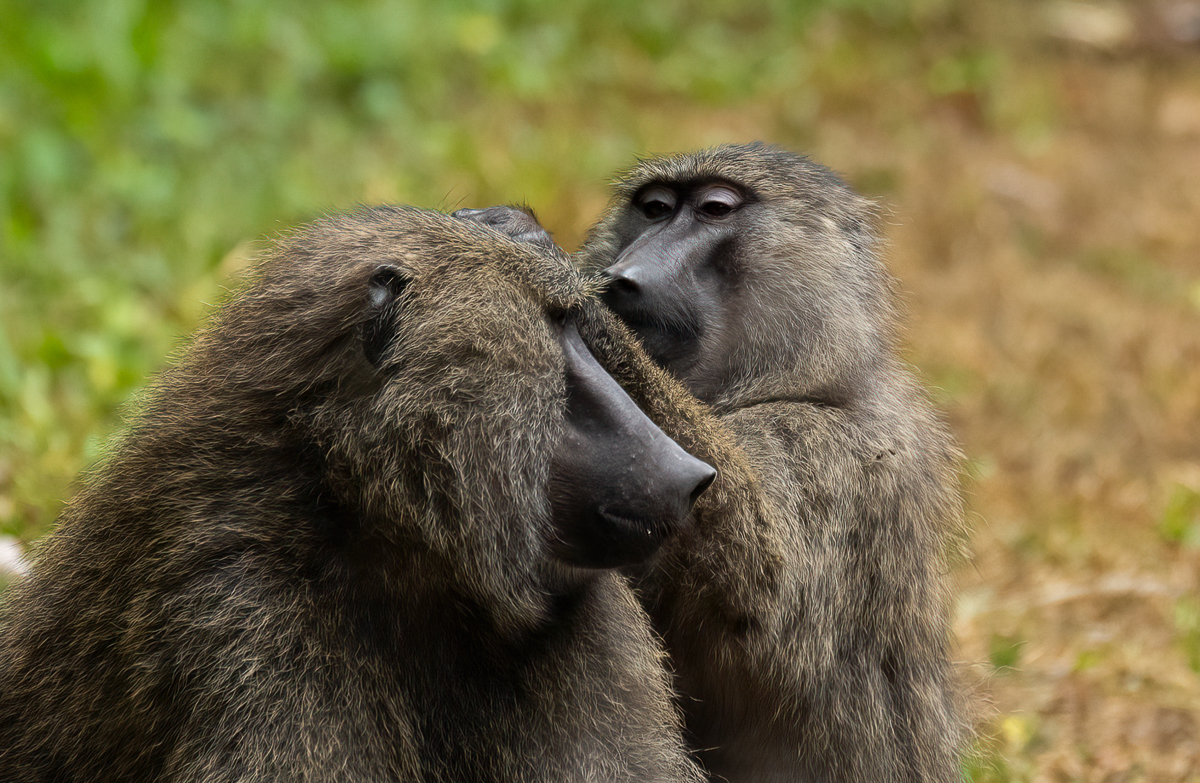
Olive baboons are large, powerful primates with dog-like faces, strong limbs, and olive-brown fur. Unlike most monkeys, they are primarily terrestrial, spending much of their time on the ground.
They are highly intelligent and opportunistic, capable of exploiting a wide range of food sources. This includes fruits, grasses, insects, small animals, and even human food when available.
Their adaptability is one of their greatest strengths—but also the reason they sometimes come into conflict with humans.
Behavior and Social Structure of Olive Baboons
Olive baboons live in large troops that can range from 20 to over 100 individuals. These groups are highly structured, with clear hierarchies based on dominance.
Males compete for rank, while females maintain stable social bonds that often last a lifetime.
Their behavior is dynamic and sometimes aggressive, especially when competing for food or protecting group members.
Because they are used to human presence in many areas, baboons can become bold. In some safari lodges and picnic areas, they are known for attempting to steal food—something visitors must take seriously.
Meet the Red-Tailed Monkey: The Agile Forest Specialist
In contrast, the red-tailed monkey (Cercopithecus ascanius) represents the forest side of Uganda’s primate diversity.
This species is smaller, more colorful, and far more arboreal than the baboon. It is commonly found in forests such as Kibale Forest National Park and along forest edges.
Red-tailed monkeys are easily identified by their reddish tail, white nose spot, and expressive face. They are fast-moving and agile, often leaping between branches high in the canopy.
Unlike baboons, they are rarely seen on the ground and tend to keep a safe distance from humans.
Behavior and Social Life of Red-Tailed Monkeys
Red-tailed monkeys live in smaller groups compared to baboons, usually ranging from 10 to 30 individuals.
Their social structure is less aggressive and more fluid. They rely heavily on vocal communication, using a range of calls to signal danger, coordinate movement, and maintain group cohesion.
They are highly alert and cautious, quickly retreating into the canopy if disturbed.
Their diet consists mainly of fruits, leaves, flowers, and insects, making them important seed dispersers in forest ecosystems.
Habitat Differences: Ground vs Canopy
One of the most important distinctions between these two primates is habitat use.
Olive baboons dominate the ground. They thrive in open savannahs, woodland areas, and forest edges. This makes them extremely visible in places like Queen Elizabeth National Park.
Red-tailed monkeys, on the other hand, are canopy specialists. They depend on forest cover and are most commonly found in areas like Kibale Forest National Park.
This difference reduces direct competition between the two species, allowing them to coexist in overlapping regions.
Intelligence and Adaptability
Both species are intelligent, but they express it differently.
Olive baboons are problem-solvers and opportunists. They adapt quickly to changing environments and can exploit human activity, which is why they are often seen near roads and lodges.
Red-tailed monkeys are more specialized. Their intelligence is focused on navigation, communication, and survival within complex forest environments.
In terms of adaptability, baboons have the advantage. In terms of ecological specialization, red-tailed monkeys are more refined.
Human Interaction: Friendly vs Problematic
Olive baboons have a complicated relationship with humans. Their boldness can lead to conflict, especially when they associate people with food.
Travelers are often warned not to feed or approach them, as this reinforces unwanted behavior.
Red-tailed monkeys, by contrast, maintain distance. They are curious but cautious, making them easier to observe without interference.
For photographers and wildlife enthusiasts, red-tailed monkeys often provide more natural and undisturbed viewing experiences.
Role in the Ecosystem
Both species play important ecological roles.
Olive baboons help control insect populations and disperse seeds across wide areas due to their ground movement.
Red-tailed monkeys are key seed dispersers within forest canopies, helping maintain tree diversity and forest regeneration.
Together, they contribute to the balance of Uganda’s ecosystems across different habitat types.
Where You’re Most Likely to See Them
You will almost certainly encounter olive baboons during any safari in Queen Elizabeth National Park or along major park roads.
Red-tailed monkeys are best seen in forested areas, especially Kibale Forest National Park, as well as forest edges near lodges and walking trails.
In some locations, both species can be seen within the same general area, but at different levels—baboons on the ground, red-tailed monkeys in the trees.
Key Differences at a Glance
Olive baboons are larger, ground-dwelling, highly social, and extremely adaptable. They are bold, visible, and sometimes confrontational.
Red-tailed monkeys are smaller, tree-dwelling, agile, and cautious. They are colorful, fast-moving, and more dependent on forest environments.
These differences make them complementary rather than competitive species within Uganda’s ecosystems.
Common but Far from Ordinary
Olive baboons and red-tailed monkeys may be the most commonly seen primates in Uganda, but they are far from ordinary.
They represent two very different survival strategies—one based on adaptability and dominance, the other on agility and specialization.
Together, they showcase the incredible diversity that makes Uganda a true primate capital.
Whether you are exploring the open plains of Queen Elizabeth National Park or the dense forests of Kibale Forest National Park, understanding these two species will enrich your safari experience and deepen your appreciation of Uganda’s wildlife.