
Uganda’s L’Hoest’s Monkey: The Rare Primate of Bwindi (Complete Guide)
In a country celebrated as the Primate Capital of the World, it is easy for lesser-known species to be overshadowed by giants like mountain gorillas and chimpanzees. Yet deep within the tangled rainforest of Bwindi Impenetrable National Park lives one of Uganda’s most fascinating and least understood primates—L’Hoest’s monkey.
This is not a primate you casually spot from a roadside or while glancing through the canopy. It is a forest-floor specialist, a quiet mover, and a master of disappearance. Seeing it requires patience, timing, and often a bit of luck.
But for those who do encounter it, the experience feels far more intimate than ticking off a common species. It is a glimpse into the deeper, more secretive layers of Uganda’s rainforest ecosystem.
What Exactly Is L’Hoest’s Monkey?
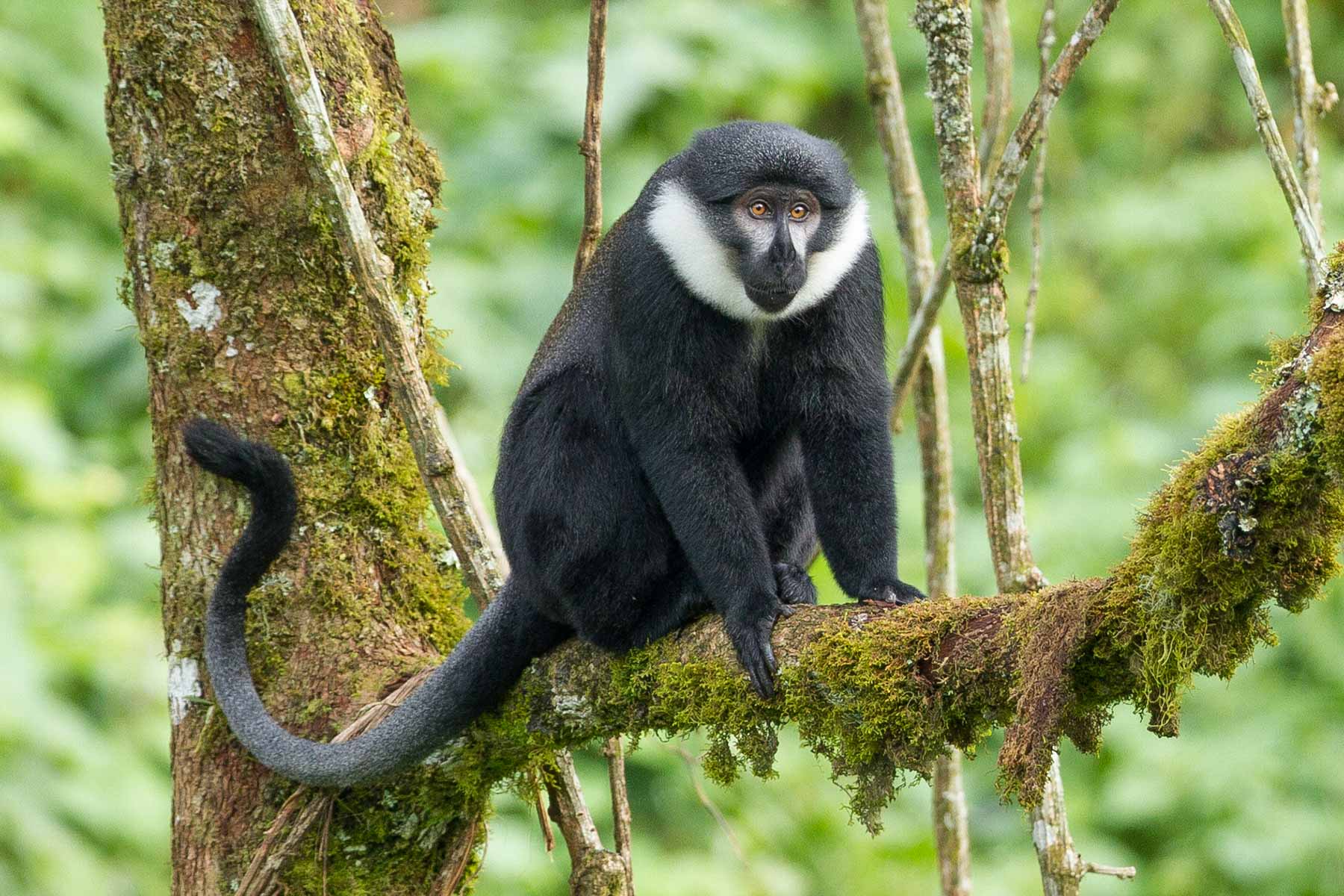
L’Hoest’s monkey (Cercopithecus lhoesti) belongs to the guenon group of Old World monkeys, a lineage known for intelligence, adaptability, and strong social structures.
Physically, it is striking in a subtle way. Its body is covered in dark brown to black fur, contrasted by a distinctive white beard that frames the face. The eyes are expressive and alert, often scanning for danger even while feeding.
Unlike many other monkeys in Uganda, L’Hoest’s monkeys are primarily terrestrial. While they can climb, they spend a significant portion of their time on the ground, moving through undergrowth rather than across treetops.
This one behavioral trait alone makes them fundamentally different from more commonly seen primates.
Why Bwindi Is Their Stronghold
The dense, ancient ecosystem of Bwindi Impenetrable National Park provides near-perfect conditions for L’Hoest’s monkeys.
Bwindi is not just any forest—it is one of Africa’s oldest surviving rainforests, estimated to be over 25,000 years old. Its vegetation is layered, chaotic, and incredibly dense, with thick undergrowth, towering trees, and a continuous supply of organic material on the forest floor.
For a terrestrial primate, this is ideal. The forest floor offers:
- Abundant fallen fruit
- Insects and small invertebrates
- Dense cover for protection
- Complex terrain that discourages predators
The steep ridges and valleys of Bwindi also create natural isolation between groups, helping maintain stable populations.
Behavior: Quiet, Strategic, and Highly Alert
L’Hoest’s monkeys are not loud or showy. Their survival depends on discretion.
They typically live in small social groups, often composed of females and young, led by a dominant male. These groups move in coordinated patterns, maintaining constant awareness of their surroundings.
When threatened, they do not panic or scatter wildly. Instead, they freeze briefly—assessing the threat—before retreating silently into dense vegetation.
This calm, calculated behavior is one reason they are so rarely seen. By the time most visitors realize they are nearby, the monkeys have already disappeared.
Diet and Feeding Strategy
L’Hoest’s monkeys are omnivorous, and their diet reflects the diversity of the forest ecosystem in Bwindi Impenetrable National Park.
They feed on:
- Fallen fruits
- Leaves and shoots
- Seeds
- Insects
- Occasionally small vertebrates
Their reliance on the forest floor gives them access to food sources that arboreal primates might ignore. This reduces competition and allows multiple species to coexist within the same habitat.
Seasonal changes influence their feeding patterns. During fruiting seasons, they focus heavily on fallen fruit, while in leaner periods they diversify their diet.
Why They Are So Rare to See
Let’s be direct—most travelers will not see L’Hoest’s monkeys, even when they are present nearby.
There are several reasons for this.
First, their terrestrial movement keeps them hidden under thick vegetation, unlike monkeys that move visibly through treetops.
Second, they are extremely cautious and avoid human presence whenever possible.
Third, their population density is naturally lower than more adaptable species like vervet monkeys or baboons.
Fourth, Bwindi itself is not an easy forest. Visibility is limited, trails are narrow, and the terrain is complex.
All of this means that a sighting is not just lucky—it is earned.
Where Else They Occur in Uganda
While Bwindi Impenetrable National Park is their most famous habitat, L’Hoest’s monkeys are also found in other forested regions such as:
- Kibale Forest National Park
- Rwenzori Mountains National Park
However, Bwindi remains one of the best places to encounter them due to its dense, undisturbed environment.
Ecological Role: Small Animal, Big Impact
Despite their low profile, L’Hoest’s monkeys play a crucial role in forest ecology.
They are important seed dispersers. By feeding on fruits and moving across the forest floor, they help regenerate plant species and maintain forest diversity.
They also contribute to insect population control and form part of the broader food web.
In simple terms, they help keep the forest functioning.
Their presence is often an indicator of a healthy, undisturbed ecosystem.
Conservation Status and Challenges
L’Hoest’s monkeys face real challenges across their range, including habitat loss, forest fragmentation, and hunting pressures.
In Uganda, protected areas like Bwindi Impenetrable National Park provide strong protection. However, outside these zones, deforestation and agricultural expansion continue to reduce suitable habitat.
Conservation strategies focus on:
- Protecting forest ecosystems
- Supporting community-based conservation
- Promoting eco-tourism as an alternative livelihood
The survival of L’Hoest’s monkeys is directly tied to the health of Uganda’s forests.
Can You See Them During Gorilla Trekking?
Yes—and this is one of the most realistic opportunities.
While trekking for gorillas in Bwindi Impenetrable National Park, guides often move through the same forest layers used by L’Hoest’s monkeys.
Occasional sightings happen during:
- Gorilla trekking routes
- Guided nature walks
- Birding excursions
However, they are always secondary sightings. No trek is specifically designed for them, which makes any encounter feel unexpected and special.
Best Strategy for Seeing L’Hoest’s Monkeys
If your goal is to maximize your chances, approach this strategically.
Early morning forest walks offer better chances, as primates are more active.
Move quietly and avoid sudden movements. Noise is the quickest way to lose a sighting.
Work with experienced guides who understand subtle signs such as movement in undergrowth or alarm calls.
Most importantly, adjust your expectations. Treat a sighting as a bonus, not a guarantee.
Why This Primate Matters More Than You Think
L’Hoest’s monkey represents a category of wildlife that is often overlooked—species that are not headline attractions but are essential to ecosystem function.
They remind us that biodiversity is not just about the most famous animals. It is about the full network of life that supports a forest.
In Bwindi Impenetrable National Park, gorillas may be the stars, but species like L’Hoest’s monkeys are part of the system that makes the forest sustainable.
A Rare Encounter Worth the Effort
L’Hoest’s monkey is not easy to find, not easy to photograph, and not easy to predict. But that is precisely what makes it valuable.
In a world where many wildlife experiences are becoming more structured and predictable, this primate offers something different—uncertainty, authenticity, and discovery.
For travelers exploring Bwindi Impenetrable National Park, it represents a deeper layer of the forest, one that rewards patience and curiosity.
And if you do see one, even briefly, you will understand why some of the most meaningful wildlife encounters are also the most fleeting.