
Waterbuck: Behaviour, Habitat and Best Viewing Spots
The waterbuck is one of Africa’s most recognizable antelopes, often seen near rivers, lakes, and wetlands where it thrives in close association with water. Scientifically known as Kobus ellipsiprymnus, this large, shaggy-coated antelope is well adapted to life along the edges of aquatic ecosystems.(Waterbuck: Behaviour, Habitat and Best Viewing Spots)
Unlike many antelope species that roam widely across dry savannah, the waterbuck is more sedentary, rarely straying far from reliable water sources. Its dependence on water, combined with its size and defensive behavior, makes it a unique and important species within African ecosystems.
Physical Characteristics and Identification
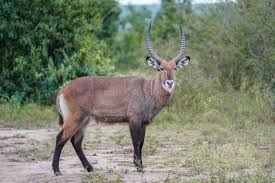
The waterbuck is a robust and heavy-bodied antelope with a coarse, grey-brown coat that appears slightly oily. This oily secretion gives the animal a strong musky odor, which is believed to deter predators.
One of its most distinctive features is the white ring around its rump, often described as a “toilet seat” marking. This marking makes it easy to identify even from a distance.
Males are larger than females and possess long, curved horns that sweep backward and then forward. These horns are used in dominance battles and territorial defense.
Habitat: Why Water Is Essential
As its name suggests, the waterbuck is closely tied to water-rich environments.
It is commonly found in:
Riverbanks
Lakeshores
Floodplains
Wetlands
In Uganda, prime locations for waterbuck sightings include:
Queen Elizabeth National Park, especially along the Kazinga Channel
Murchison Falls National Park, near the Nile River and delta areas
Lake Mburo National Park, where lakes and wetlands support stable populations
These environments provide both food and protection, as waterbuck often use water as an escape route from predators.
Behaviour and Social Structure
Waterbucks are generally found in small groups or herds, though adult males are often territorial and may be seen alone.
Their social structure typically includes:
Females and young forming loose herds
Dominant males defending territories
Bachelor males living on the outskirts
Territorial males mark their areas using scent and defend them against rivals. These territories are usually located near water sources, ensuring access to both food and safety.
Waterbucks are less mobile than other antelope species, often remaining within a defined home range for long periods.
Feeding Habits
Waterbucks are grazers, feeding primarily on grasses found in moist environments.
Their diet includes:
Fresh grasses near water
Occasionally reeds and aquatic plants
They prefer lush, green vegetation and are often seen grazing in the early morning and late afternoon.
Unlike some antelopes, waterbucks do not venture far in search of food, relying instead on the consistent availability of vegetation near water sources.
Anti-Predator Adaptations
Waterbucks have several adaptations that help them survive in predator-rich environments.
Their large size makes them less vulnerable than smaller antelopes, while their strong legs allow them to run quickly when threatened.
One of their most effective strategies is retreating into water. When chased by predators such as lions, waterbucks may enter rivers or lakes, where they are more difficult to attack.
Their musky odor is also believed to make their meat less appealing to predators, although this does not completely protect them.
Reproduction and Life Cycle
Waterbucks do not have a strict breeding season and can reproduce throughout the year.
Females give birth to a single calf after a gestation period of about 7–8 months. Calves are usually hidden in vegetation for the first few weeks of life to avoid predators.
Mothers are highly protective, and calves gradually join the herd as they grow stronger.
Male dominance plays a key role in breeding, with territorial males having greater access to females within their range.
Best Viewing Spots in Uganda
Waterbucks are relatively easy to spot due to their size and preference for open areas near water.
Some of the best viewing locations include:
Queen Elizabeth National Park, particularly during boat safaris along the Kazinga Channel
Murchison Falls National Park, especially along riverbanks and floodplains
Lake Mburo National Park, where they are frequently seen near lakeshores
Boat safaris offer especially good opportunities to observe waterbucks up close, as they often graze near the water’s edge.
Best Time to See Waterbucks
Waterbucks can be seen year-round in Uganda.
They are most active during:
Early morning
Late afternoon
Dry seasons often provide better visibility, as animals gather near remaining water sources and vegetation is less dense.
However, because they stay close to water, sightings are generally reliable in all seasons.
Ecological Importance
Waterbucks play a significant role in maintaining the balance of wetland and savannah ecosystems.
As grazers, they help control grass growth and contribute to nutrient cycling.
They are also an important prey species for large predators, supporting the broader food chain.
Their presence is often an indicator of healthy water-based ecosystems.
Final Thoughts
The Kobus ellipsiprymnus is a key species in Africa’s wetland and savannah environments, combining size, resilience, and strong ties to water.
In Uganda, sightings in Queen Elizabeth National Park and Murchison Falls National Park offer excellent opportunities to observe their behavior up close.
For safari travelers, the waterbuck represents a different side of the African wilderness—one shaped by rivers, lakes, and the constant interaction between land and water.