
Painted Wild Dog: Africa’s Most Successful Predator
The painted wild dog, also known as the African wild dog, is one of the most efficient and socially coordinated predators in the world. Scientifically known as Lycaon pictus, this rare carnivore is instantly recognizable by its patchwork coat of black, brown, yellow, and white, giving it a “painted” appearance.
Despite being one of Africa’s most endangered large predators, it is also one of the most successful hunters in terms of kill success rate. Its combination of teamwork, endurance, and intelligence makes it a highly specialized predator adapted for long-distance pursuit hunting across open savannahs.
Why Painted Wild Dogs Are So Successful
Painted wild dogs are considered the most efficient hunters in Africa because of their extraordinary coordination and stamina. Unlike lions or leopards, which rely on strength or stealth, wild dogs depend entirely on teamwork.
A hunting pack operates like a highly synchronized unit, with individuals taking turns leading the chase. This allows them to maintain high speeds over long distances without exhausting a single individual.
Their success rate in hunts can exceed 70–80%, significantly higher than most large predators. This efficiency ensures the pack remains well-fed and stable.
Hunting Behaviour: Endurance and Teamwork
The hunting strategy of painted wild dogs is built on persistence rather than ambush.
A typical hunt involves:
- Locating prey through coordinated movement
- Chasing in relay formation, where dogs rotate positions
- Communicating continuously through vocal signals
- Targeting medium-sized herbivores such as impala, gazelle, and young wildebeest
Unlike solitary predators, wild dogs do not give up easily. They maintain pressure on prey until it becomes exhausted, often over several kilometers.
Once the prey is caught, the pack feeds quickly and cooperatively, with minimal conflict between individuals.
Social Structure: One of the Most Organized in the Animal Kingdom
Painted wild dogs live in tightly bonded packs that can range from a few individuals to over 20 members.
Their social structure is highly cooperative and is led by a dominant breeding pair, known as the alpha male and alpha female.
Key characteristics of pack life include:
- Strong cooperation in hunting and pup care
- Non-aggressive feeding hierarchy
- Shared responsibility in raising young
- High levels of social bonding and communication
Unlike many predators, wild dogs show very little internal conflict. This social harmony is one of the key reasons for their hunting success.
Communication and Coordination
Painted wild dogs use a complex system of vocalizations, body language, and social cues to coordinate hunts and maintain pack unity.
They communicate through:
- High-pitched twittering and chirping sounds
- Scent marking for territory boundaries
- Visual signals during movement and hunting
Before a hunt, packs often engage in a “greeting ceremony,” where members interact excitedly to build group cohesion and synchronize movement.
This coordination ensures that the pack moves as a single unit during high-speed chases.
Habitat and Distribution
Painted wild dogs prefer open savannahs, woodlands, and semi-arid regions where visibility is high and prey can be tracked over long distances.
In East Africa, they are found in select protected areas, including:
Serengeti National Park, one of their strongest remaining populations
Maasai Mara National Reserve, where occasional sightings occur
Selous Game Reserve (Nyerere National Park area), a key stronghold for the species
Kruger National Park, another important population center
Their range has declined significantly due to habitat fragmentation and human conflict.
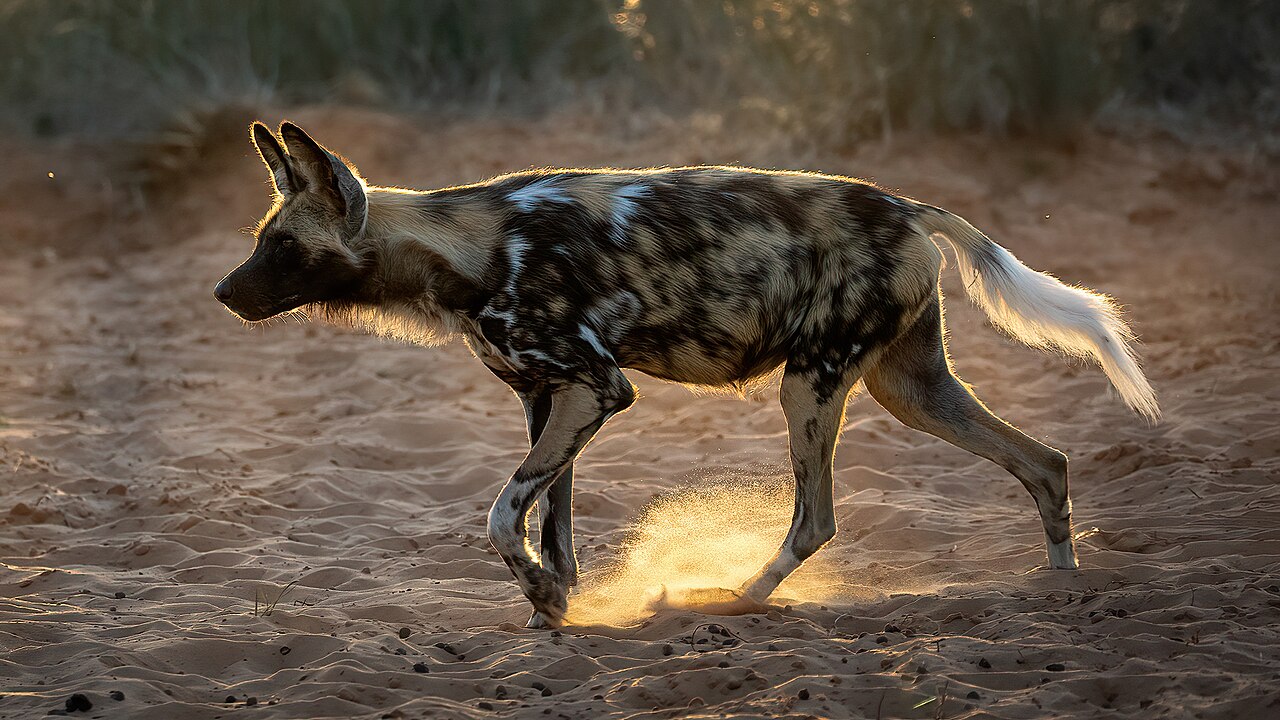
Reproduction and Pup Rearing
Wild dog reproduction is centered around the dominant breeding pair, but the entire pack participates in raising pups.
Females give birth in dens, often hidden underground or in dense vegetation. Litters can be large, sometimes exceeding 10 pups.
After birth, pups are cared for collectively by the pack. Adults regurgitate food for them and protect them from predators such as lions and hyenas.
This cooperative breeding system greatly increases pup survival rates in the wild.
Competition and Survival Challenges
Despite being highly efficient hunters, painted wild dogs face major threats from larger predators.
Lions often kill wild dogs when encountered, and hyenas frequently compete with them for food. Even though wild dogs are skilled hunters, they are physically less powerful than these competitors.
Human activities also pose significant threats, including:
- Habitat fragmentation
- Road accidents
- Disease transmission from domestic dogs
- Persecution by livestock owners
These challenges have contributed to their endangered status.
Conservation Status
The painted wild dog is currently classified as Endangered, with declining populations across much of its historic range.
Conservation efforts focus on:
- Protected area management
- Anti-poaching measures
- Disease control programs
- Community coexistence initiatives
Maintaining large, connected landscapes is essential for their survival, as they require extensive territories for hunting.
Ecological Role
Painted wild dogs play an important role in maintaining ecosystem balance by regulating herbivore populations.
Their hunting removes weaker or slower individuals, contributing to healthier prey populations and preventing overgrazing in sensitive habitats.
As apex predators, they help maintain the natural structure of savannah ecosystems.
Best Time to See Painted Wild Dogs
Sightings are rare and unpredictable, but best chances occur during early morning and late afternoon when packs are most active.
Dry seasons improve visibility due to thinner vegetation and concentrated prey movements.
Because of their wide-ranging behavior, tracking wild dogs often requires experienced guides and patience.
Final Thoughts
The Lycaon pictus is one of Africa’s most remarkable predators, defined not by individual strength but by extraordinary cooperation and intelligence.
Its high hunting success rate, complex social structure, and endurance-based strategy make it one of the most efficient carnivores on the continent.
For safari travelers, encountering painted wild dogs in places like Serengeti National Park is a rare and unforgettable experience. It reveals a side of Africa’s wildlife where teamwork, strategy, and survival are perfectly balanced in one of nature’s most sophisticated hunting systems.