
Mountain Gorilla Facts: 25 Things You Didn’t Know
Mountain gorillas are among the most fascinating and iconic wildlife species on Earth. Found only in a small region of East Africa, these gentle giants captivate travelers who venture into forests like Bwindi Impenetrable National Park and Mgahinga Gorilla National Park. Scientifically known as Mountain Gorilla, they are a subspecies of the eastern gorilla and are critically important to conservation efforts worldwide.
Below are 25 remarkable facts that reveal just how unique and intelligent these primates truly are.
Habitat and Distribution
Mountain gorillas live in only two isolated populations in the world. One group inhabits the Virunga Mountains, spanning Uganda, Rwanda, and the Democratic Republic of Congo, while the other resides in Uganda’s Bwindi forest.
They thrive at high altitudes, often between 2,200 and 4,300 meters above sea level, in dense montane and bamboo forests. These cold, misty environments are unlike the typical “African safari” landscapes many travelers imagine.
Physical Strength and Size
Mountain gorillas are the largest living primates. Adult males, known as silverbacks, can weigh up to 200 kilograms or more.
Despite their immense strength—estimated to be several times stronger than a human—they are generally calm and non-aggressive unless threatened.
Their thick fur is longer than that of other gorilla subspecies, an adaptation to the cold mountain climate.
Social Structure and Family Life
Mountain gorillas live in tight-knit family groups led by a dominant silverback. These groups can range from a few individuals to over 20 members.
The silverback plays multiple roles: protector, decision-maker, and mediator. He determines feeding locations, resolves conflicts, and defends the group from threats.
Family bonds are strong. Grooming, playing, and close physical contact are common, reinforcing social cohesion.
Diet and Feeding Habits
Mountain gorillas are primarily herbivorous. Their diet consists of leaves, shoots, stems, and occasionally fruits.
An adult gorilla can consume up to 30 kilograms of vegetation per day. Because their diet is so water-rich, they rarely need to drink from external water sources.
They spend a significant portion of their day feeding, moving slowly through the forest as they forage.
Intelligence and Communication
Mountain gorillas are highly intelligent animals with complex communication systems.
They use a variety of vocalizations, including grunts, hoots, and roars, to communicate with one another. Body language—such as chest-beating—is also an important form of expression.
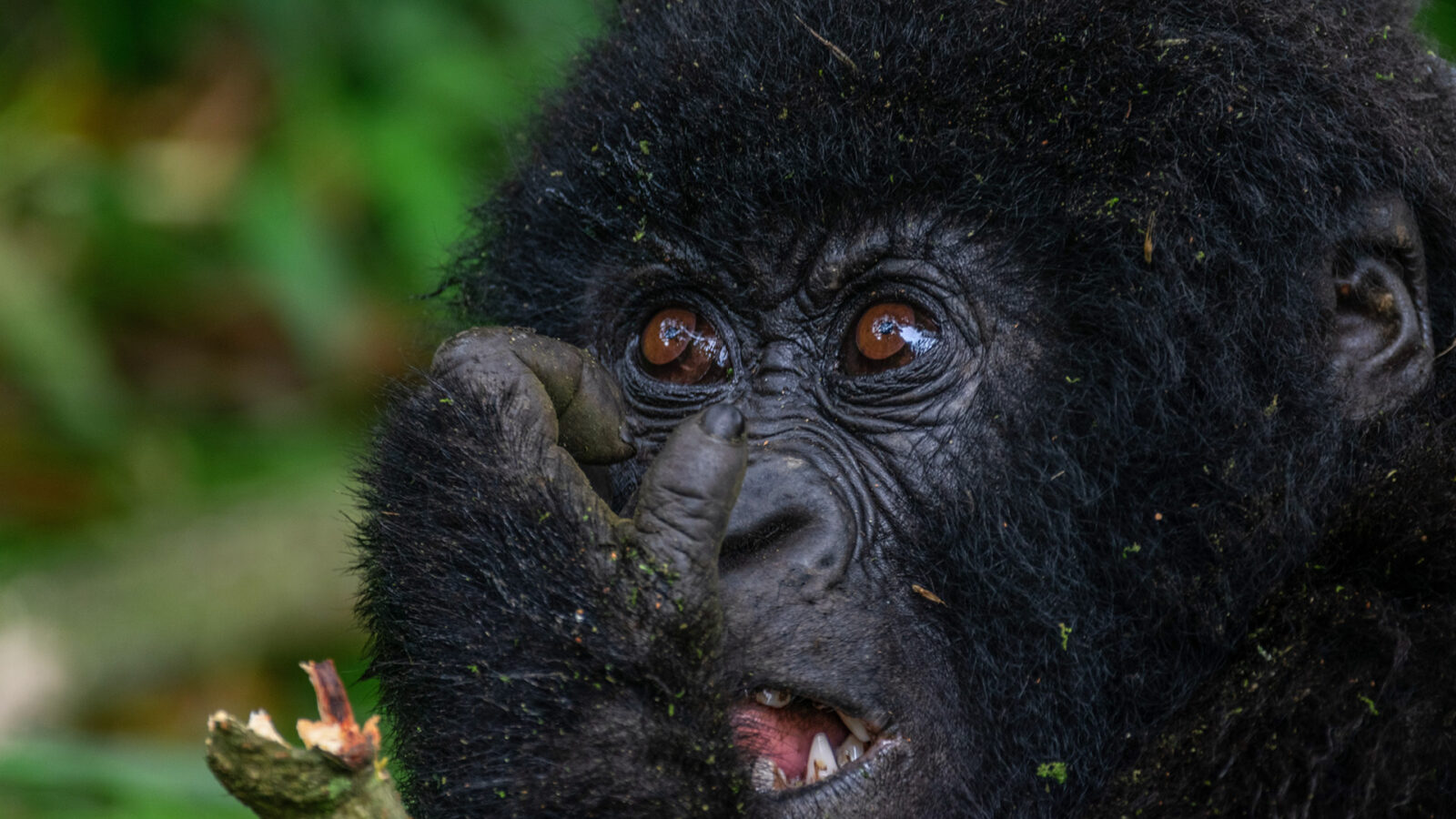
Each gorilla has a unique nose print, similar to a human fingerprint, which researchers use to identify individuals.
Reproduction and Lifespan
Female gorillas typically give birth to one infant after a gestation period of about 8.5 months.
Infants are heavily dependent on their mothers and will ride on their backs as they grow. The bond between mother and infant is extremely strong.
Mountain gorillas can live up to 35–40 years in the wild, although this varies depending on environmental conditions and threats.
Conservation and Population Recovery
Mountain gorillas were once on the brink of extinction. However, thanks to conservation efforts, their population has been steadily increasing.
Today, they are one of the few endangered species whose numbers are rising. Strict protection, anti-poaching measures, and regulated tourism have all contributed to their recovery.
Organizations like Dian Fossey Gorilla Fund have played a major role in protecting these animals and their habitats.
Behavior and Daily Life
Mountain gorillas build new nests every night using leaves and branches. These nests are constructed either on the ground or in trees, depending on the age and preference of the gorilla.
They are diurnal, meaning they are active during the day and rest at night.
Play is an important part of life, especially for young gorillas, who engage in wrestling, climbing, and chasing games.
Interaction with Humans
Mountain gorillas share about 98% of their DNA with humans, making them one of our closest relatives.
They are generally peaceful toward humans, especially in habituated groups used for tourism. However, strict rules are in place during trekking to minimize disturbance and prevent disease transmission.
Maintaining a safe distance and following guide instructions is essential when visiting gorillas in the wild.
Unique and Surprising Facts
Mountain gorillas cannot survive in captivity. Unlike other primates, they have never adapted well to zoo environments.
They have individual personalities. Some are playful and curious, while others are shy or reserved.
Silverbacks develop a patch of silver hair on their backs as they mature, which gives them their name.
Gorillas can catch human diseases, including the common cold, which is why health precautions are critical during visits.
They rarely show aggression without reason. Most displays, such as chest-beating, are meant to communicate dominance rather than initiate conflict.
Final Thoughts: Why Mountain Gorillas Matter
Mountain gorillas are more than just a safari highlight—they are a symbol of conservation success and a reminder of the delicate balance between humans and nature.
Encountering them in places like Bwindi Impenetrable National Park is a profound experience that goes beyond wildlife viewing. It offers a glimpse into a complex social world that mirrors our own in surprising ways.
Protecting these incredible animals ensures that future generations can continue to witness one of the most extraordinary species on Earth, thriving in the misty forests of East Africa.