
Chimpanzee Facts: Intelligence, Society and Behaviour
Chimpanzees are among the most intelligent and socially complex animals on Earth. Found across parts of equatorial Africa, these remarkable primates share a deep evolutionary connection with humans and display behaviors that often feel strikingly familiar. In Uganda, chimpanzees are a major highlight for travelers visiting forests such as Kibale National Park and Budongo Forest Reserve, where guided tracking experiences offer a close look into their world.
Scientifically known as Chimpanzee, chimpanzees are not only fascinating to observe but also crucial to understanding human evolution, intelligence, and social systems.
Intelligence: One of Humanity’s Closest Relatives
Chimpanzees share approximately 98–99% of their DNA with humans, making them one of our closest living relatives. This genetic similarity is reflected in their cognitive abilities, which are among the most advanced in the animal kingdom.
They are capable of problem-solving, planning, and even basic forms of reasoning. In controlled studies, chimpanzees have demonstrated memory skills that rival or exceed those of humans in certain tasks, particularly short-term visual memory.
One of their most impressive traits is tool use. Chimpanzees create and use tools for various purposes, such as using sticks to extract termites from mounds or stones to crack open nuts. This ability is not instinctive alone—it is learned, refined, and passed down through generations, forming a kind of cultural knowledge.
Communication and Language
Chimpanzees possess a complex communication system that includes vocalizations, facial expressions, and body language. They use different calls to signal danger, food availability, or social interactions.
Gestures play a significant role in their communication. A simple hand movement or posture can convey intent, emotion, or instruction to other members of the group.
Research has shown that chimpanzees can learn elements of human language systems, including sign language and symbolic communication. While they do not speak in the human sense, their ability to understand and use symbols demonstrates a high level of cognitive sophistication.
Social Structure: Life in a Community
Chimpanzees live in communities that can range from 20 to over 100 individuals. These communities are organized in what is known as a “fission-fusion” society, meaning that the group frequently splits into smaller subgroups and then reunites.
Within these societies, there is a clear hierarchy, especially among males. Dominance is established through displays of strength, alliances, and social intelligence rather than constant aggression.
Female chimpanzees often move between communities, while males typically remain in their birth group. Strong social bonds are maintained through grooming, cooperation, and shared activities.
In Uganda’s Kibale National Park, some chimpanzee communities have been habituated to human presence, allowing researchers and tourists to observe these social dynamics up close.
Cooperation and Conflict
Chimpanzees are capable of both cooperation and conflict, reflecting the complexity of their social lives.
They work together during hunting, particularly when targeting small monkeys. Different individuals take on specific roles, demonstrating coordination and strategic thinking.
At the same time, conflicts can arise within and between groups. These disputes may involve competition for food, mates, or dominance. While aggression does occur, it is often balanced by reconciliation behaviors such as grooming or submissive gestures.
This dual capacity for cooperation and conflict highlights the depth of chimpanzee social intelligence.
Emotional Intelligence and Relationships
Chimpanzees exhibit a wide range of emotions, including joy, fear, empathy, and grief. They form strong bonds with family members and allies, and these relationships can last for many years.
Mothers are highly attentive to their young, nurturing them for several years. Infant chimpanzees rely heavily on their mothers for protection, learning, and emotional support.
There is evidence that chimpanzees mourn the loss of group members. They may stay near a deceased individual, show signs of distress, or change their behavior temporarily.
These emotional responses provide insight into the evolutionary roots of human feelings and relationships.
Daily Behaviour and Lifestyle
Chimpanzees are diurnal, meaning they are active during the day. Their daily routine typically revolves around feeding, socializing, and resting.
They are omnivorous, with a diet that includes fruits, leaves, seeds, insects, and occasionally meat. Fruit is a primary food source, and its availability often influences movement patterns.
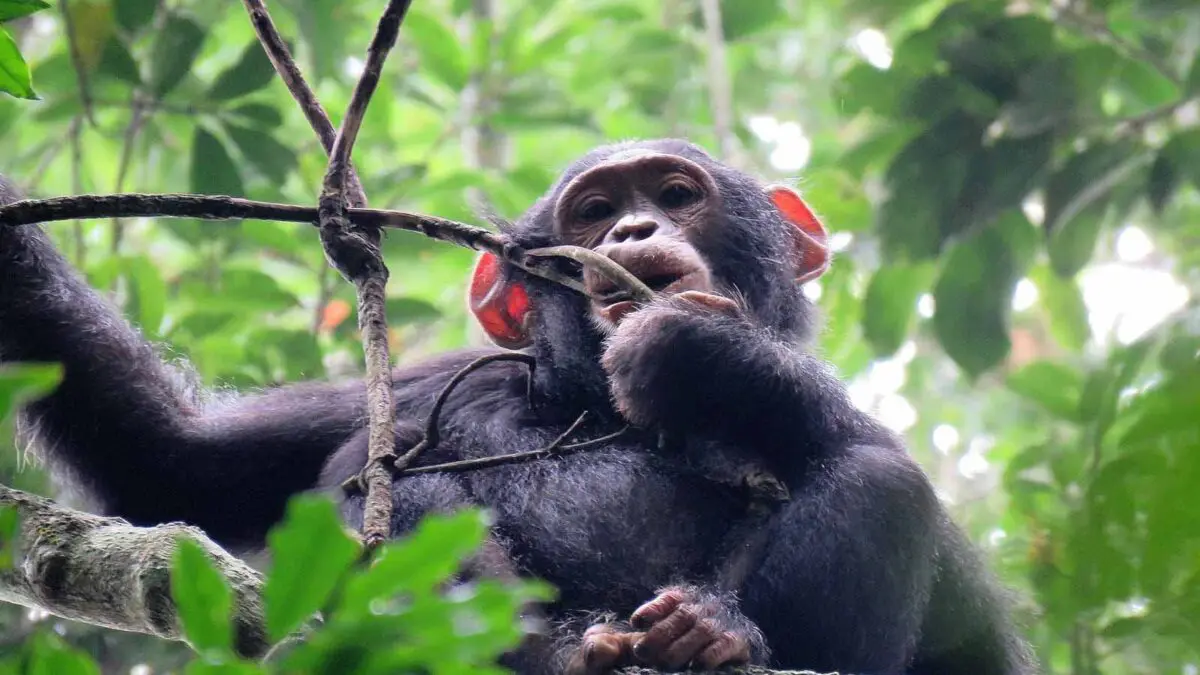
Each evening, chimpanzees build nests in trees using branches and leaves. These nests are used for sleeping and are rebuilt daily.
Movement through the forest is both terrestrial and arboreal. While they spend time on the ground, chimpanzees are excellent climbers and often retreat to trees for safety or rest.
Cultural Behaviour and Learning
One of the most fascinating aspects of chimpanzee life is the presence of culture. Different communities exhibit unique behaviors that are learned and transmitted socially.
For example, some groups use specific techniques for termite fishing, while others have distinct grooming rituals or communication signals. These variations are not due to environmental differences alone but reflect learned traditions.
Young chimpanzees learn by observing and imitating adults, particularly their mothers. This process of social learning is fundamental to the development of skills and behaviors within the group.
Conservation and Threats
Chimpanzees face several threats in the wild, including habitat loss, poaching, and disease. Conservation efforts are essential to ensure their survival.
Protected areas like Budongo Forest Reserve and Kibale National Park play a crucial role in safeguarding chimpanzee populations.
Organizations such as Jane Goodall Institute have been instrumental in research and conservation, helping to raise awareness and promote sustainable practices.
Responsible tourism, including regulated chimpanzee tracking, contributes to conservation by generating revenue and supporting local communities.
Chimpanzees and Humans: A Shared Story
Chimpanzees offer a mirror into our own evolutionary past. Their intelligence, social complexity, and emotional depth reveal how closely connected we are.
Observing chimpanzees in the wild is not just a wildlife experience—it is an opportunity to reflect on the origins of human behavior and society.
In forests like Kibale National Park, encounters with chimpanzees are often described as deeply moving, as travelers witness behaviors that feel both familiar and profoundly wild.
Final Thoughts: Understanding Our Primate Cousins
Chimpanzees are more than just another species on a safari checklist. They are thinkers, communicators, and social beings with intricate lives and relationships.
Their intelligence challenges our understanding of what it means to be human, while their vulnerability reminds us of our responsibility to protect them.
By learning about their behaviour, supporting conservation efforts, and experiencing them respectfully in the wild, we contribute to ensuring that chimpanzees continue to thrive in Uganda’s forests for generations to come.