
Nile Crocodile Facts: Size, Speed and Where to See Them
The Nile crocodile is one of Africa’s most ancient and efficient predators, virtually unchanged for millions of years. It is a creature built for patience, power, and precision—an ambush hunter that dominates rivers, lakes, and wetlands across sub-Saharan Africa. In Uganda, it is commonly encountered in major waterways within protected areas such as Murchison Falls National Park and Queen Elizabeth National Park, where it plays a crucial role in aquatic ecosystems.
Scientifically known as Nile Crocodile, this reptile is both feared and deeply respected. It is one of Africa’s top aquatic predators and a key species for understanding river ecology, predator behavior, and evolutionary survival strategies.
Ancient Design: A Perfect Predator
The Nile crocodile is often described as a “living fossil” because its body structure has changed very little for over 200 million years. Its design is highly specialized for survival in water-based environments.
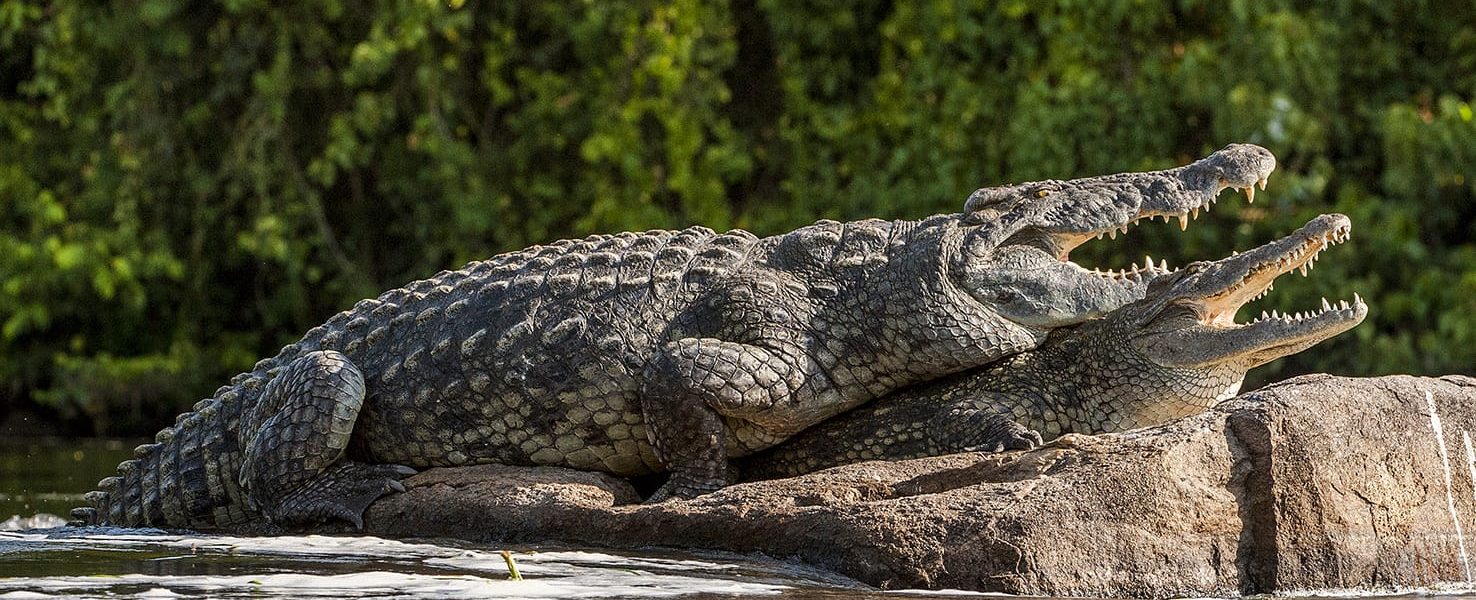
Its long, armored body is covered in thick, bony scales called osteoderms, which provide natural protection against injury and even some predator attacks when young. The crocodile’s eyes, ears, and nostrils are positioned on top of its head, allowing it to remain almost fully submerged while still monitoring its surroundings.
This adaptation makes it an exceptional ambush predator. It can stay completely still underwater for long periods, waiting for prey to approach the water’s edge.
Size and Physical Power
Nile crocodiles are among the largest reptiles in the world. Adult males commonly reach lengths of 4 to 5 meters, although some exceptional individuals can exceed this. Their weight can range from 225 kilograms to over 700 kilograms depending on age and habitat conditions.
Despite their bulky appearance, crocodiles are incredibly muscular. Their tails alone provide powerful propulsion in water, enabling sudden bursts of speed during attacks.
Their bite force is among the strongest in the animal kingdom, capable of crushing bones and holding onto struggling prey with extraordinary grip strength. Once a crocodile secures its prey, escape becomes extremely difficult.
Speed: Fast in Water, Explosive on Land
While crocodiles appear slow and sluggish on land, they are surprisingly fast over short distances. On land, they can “gallop” in brief bursts, reaching speeds of up to 12–14 km/h, though only for short periods.
In water, however, they are far more agile. Their streamlined bodies and powerful tails allow them to move quickly and silently beneath the surface. This underwater stealth is what makes them such effective hunters.
The attack itself is explosive. A crocodile can launch from near-total stillness into a rapid strike in less than a second, often catching prey completely off guard.
Hunting Strategy: Patience and Precision
The Nile crocodile is an ambush predator that relies on patience rather than pursuit. It typically waits near riverbanks, partially submerged, watching for animals that come to drink.
When prey approaches, the crocodile strikes with incredible speed, grabbing the animal and dragging it into the water. This “death roll” technique is used to subdue and disorient prey while tearing off manageable pieces of flesh.
Common prey includes fish, birds, antelopes, and occasionally large mammals such as buffalo or even young elephants in rare cases. The crocodile’s diet depends heavily on size and opportunity.
In ecosystems like those found in Queen Elizabeth National Park, crocodiles often feed on fish and animals crossing river channels during migration or movement.
Behaviour and Intelligence
Although reptiles are not typically associated with high intelligence, Nile crocodiles display surprisingly complex behavior. They are capable of learning patterns, recognizing feeding opportunities, and adapting to environmental changes.
Mother crocodiles exhibit strong parental care, guarding their nests and protecting hatchlings after they emerge. This is relatively rare among reptiles and shows a more advanced behavioral adaptation.
Communication also plays a role in crocodile behavior. They produce vocalizations, especially during breeding seasons, and use body movements to signal dominance or territory.
Reproduction and Early Life
Female Nile crocodiles lay between 20 and 80 eggs in sandy nests near water. The temperature of the nest determines the sex of the hatchlings, a biological phenomenon known as temperature-dependent sex determination.
After laying eggs, the female guards the nest fiercely for about three months. When the eggs begin to hatch, she assists the young crocodiles by gently carrying them to water in her mouth.
Hatchlings are extremely vulnerable and face high predation rates from birds, fish, and even other crocodiles. Only a small percentage survive to adulthood.
Habitat: Rivers, Lakes and Wetlands
Nile crocodiles are highly adaptable and can live in a variety of freshwater environments. They are most commonly found in rivers, lakes, swamps, and marshes.
In Uganda, major populations exist along the Nile River system, particularly in Murchison Falls National Park, where the river’s strong currents and abundant wildlife create ideal hunting conditions.
They also inhabit Lake Victoria and other large water bodies, often near fishing communities where fish are abundant.
Role in the Ecosystem
Nile crocodiles are apex predators in aquatic environments. They help regulate fish populations and control the numbers of animals that rely on water sources.
By feeding on weak or sick animals, they contribute to natural selection and ecosystem balance. Their presence also influences animal behavior, as many species become more cautious near water bodies where crocodiles are active.
This ecological role makes them an essential part of wetland and river health.
Human Encounters and Risk
Nile crocodiles are responsible for more human fatalities than almost any other wild animal in Africa. This is largely due to their proximity to human settlements along rivers and lakes.
Most attacks occur when people collect water, fish, or bathe near crocodile habitats. Their camouflage and stealth make them extremely difficult to detect.
However, crocodiles do not actively hunt humans as preferred prey. Encounters are typically opportunistic rather than intentional targeting.
In safari contexts, visitors are usually safe when observing from boats or designated viewing points, provided they follow guide instructions.
Where to See Nile Crocodiles in Uganda
Uganda offers some of the best opportunities in Africa to observe Nile crocodiles in the wild.
One of the most reliable locations is Murchison Falls National Park, where crocodiles bask along the Nile River banks and hunt in fast-moving waters below the falls.
Another excellent location is Queen Elizabeth National Park, particularly along the Kazinga Channel, which is famous for dense concentrations of hippos and crocodiles sharing the same waters.
Boat safaris are the safest and most effective way to observe them. Crocodiles often remain motionless on sandbanks, making them easy to spot when conditions are right.
Conservation Status
The Nile crocodile is currently not endangered and is classified as a species of least concern. However, it has faced historical pressure from hunting for its skin and habitat loss.
Today, regulated conservation and sustainable use programs help maintain stable populations in many regions.
In protected areas like Uganda’s national parks, crocodile populations are generally healthy and well-managed.
Power, Patience and Survival
The Nile crocodile is a master of survival—an animal that has perfected the art of waiting, striking, and enduring over millions of years.
In places like Murchison Falls National Park, watching a crocodile glide silently through the Nile is a reminder of nature’s precision and power.
It is not the fastest or most social animal, but it is one of the most efficient predators on Earth. Its success lies in patience, stealth, and an evolutionary design that has stood the test of time.
The Nile crocodile remains one of Africa’s most iconic and respected creatures—a silent ruler of rivers and a symbol of ancient survival in the modern world.