
Exploring the Rwenzori Mountains: What Trekkers Need to Know
Rwenzori Mountains National Park is one of Africa’s most challenging, dramatic, and scientifically unique trekking destinations. Often referred to as the “Mountains of the Moon,” the Rwenzori range is not volcanic like Kilimanjaro or Mount Elgon, but a fault-block mountain system formed by tectonic uplift along the Albertine Rift. This geological origin has created a jagged, glacier-topped landscape that feels more alpine than tropical, despite its location near the equator.
For trekkers, the Rwenzoris represent one of the most demanding mountain experiences in Africa—offering high-altitude hiking, technical terrain, extreme weather variability, and some of the most surreal ecological zones on the continent.
Location and Overview
Rwenzori Mountains National Park is located in western Uganda along the border with the Democratic Republic of the Congo. The range stretches approximately 120 kilometers in length and 65 kilometers in width, forming part of the larger Albertine Rift Valley system.
The highest peak is Margherita Peak on Mount Stanley, which rises to 5,109 meters above sea level, making it the third-highest peak in Africa after Kilimanjaro and Mount Kenya. Unlike those more famous mountains, the Rwenzoris are not cone-shaped volcanoes but a complex system of ridges, valleys, and ice-capped summits.
This region is recognized as a UNESCO World Heritage Site due to its exceptional biodiversity, rare alpine ecosystems, and permanent glaciers near the equator.
Geological Formation
The Rwenzori Mountains are a result of tectonic uplift rather than volcanic activity. As the African tectonic plates shifted, sections of the Earth’s crust were pushed upward, forming a massive block of uplifted rock.
Over millions of years, glaciation, erosion, and rainfall carved deep valleys and sharp ridges into the mountain system. This has created a highly fragmented landscape with steep gradients, unstable slopes, and rapidly changing ecological zones.
Unlike volcanic mountains, the Rwenzoris contain ancient metamorphic rocks, including gneiss and schist, which contribute to their rugged appearance and complex terrain.
Ecological Zones and Biodiversity
One of the most remarkable features of Rwenzori Mountains National Park is its vertical ecological diversity. As trekkers ascend the mountain, they pass through multiple distinct vegetation zones within a relatively short distance.
The lower slopes are dominated by tropical rainforest, home to chimpanzees, colobus monkeys, and a wide range of bird species. As elevation increases, the forest transitions into bamboo zones and then into montane forest.
Above this lies the heath and moorland zone, characterized by giant lobelias, giant groundsels, and moss-covered vegetation. These surreal plant forms are adapted to cold, wet, and high-altitude conditions.
Near the summit, the landscape becomes alpine and glacial, with ice fields, rocky outcrops, and extreme weather conditions.
This rapid transition of ecosystems makes the Rwenzoris one of the most biologically diverse mountain environments in Africa.
Trekking Routes and Difficulty
Trekking in the Rwenzoris is significantly more demanding than most other African mountain climbs. The terrain is wet, muddy, steep, and often unstable due to heavy rainfall and dense vegetation.
Several routes are available, including the Central Circuit Trail and the Kilembe Trail. Both routes typically take between 7 and 10 days to reach the main peaks, depending on weather conditions and acclimatization needs.
Unlike Kilimanjaro, where the ascent is relatively direct, Rwenzori trekking involves continuous up-and-down movement across valleys and ridges. This increases physical strain and requires strong endurance.
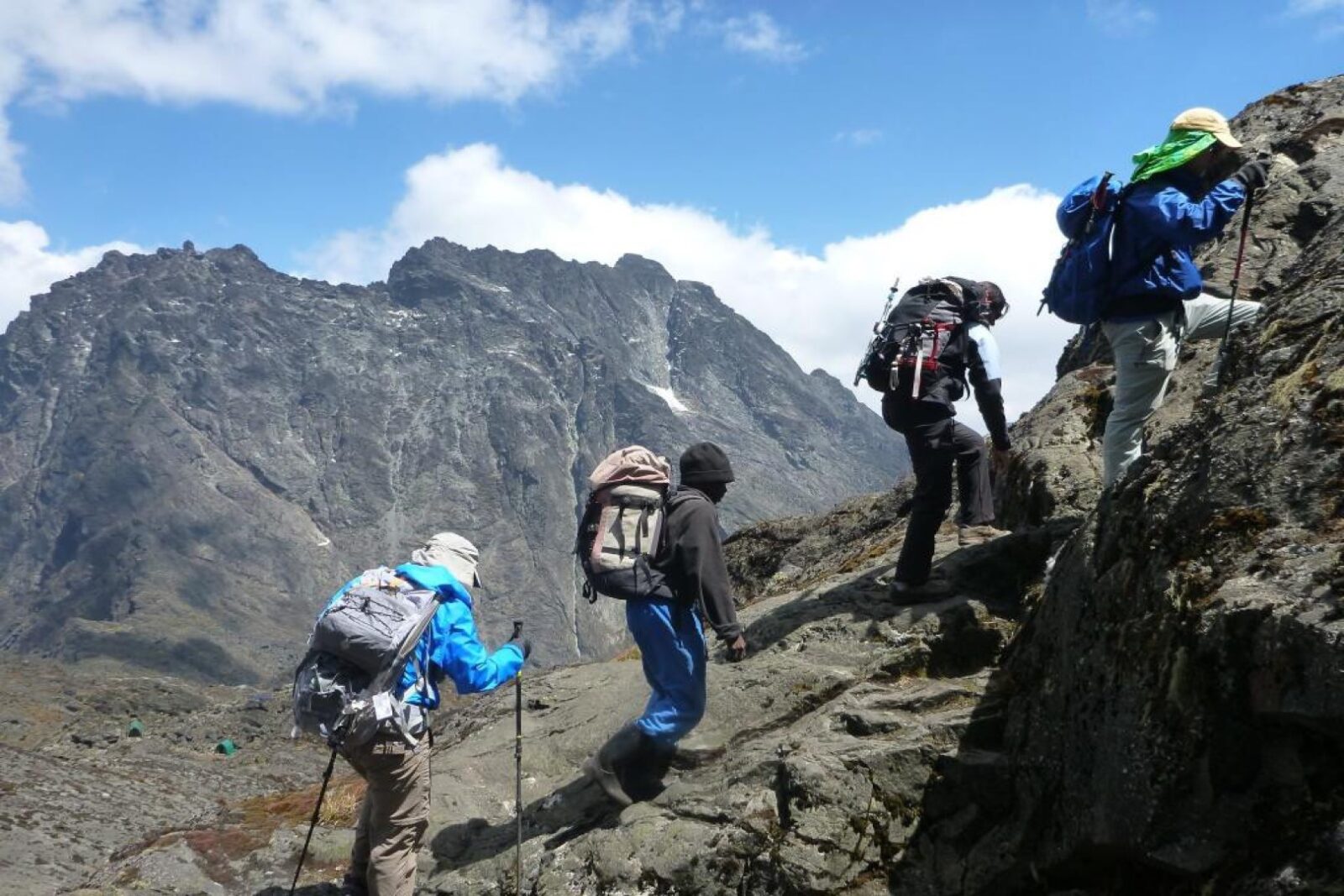
Summit attempts to Margherita Peak require basic mountaineering skills, including the use of crampons, ropes, and ice axes due to glacier crossings.
Weather and Conditions
The Rwenzori climate is one of the most challenging aspects of the trek. The region experiences frequent rainfall throughout the year, resulting in extremely wet conditions.
Trails are often muddy, slippery, and covered in dense vegetation. Waterproof gear is essential, and trekkers must be prepared for sudden weather changes.
Temperatures vary significantly with altitude. While lower zones are warm and humid, higher elevations can experience freezing conditions, especially near glaciers.
Because of this variability, proper layering, waterproof clothing, and high-quality trekking equipment are critical for safety and comfort.
Wildlife and Natural Encounters
Although primarily a trekking destination, Rwenzori Mountains National Park is also home to diverse wildlife.
Lower forest zones host primates such as black-and-white colobus monkeys, blue monkeys, and chimpanzees. Forest elephants and duikers are also present but rarely seen due to dense vegetation.
Birdlife is particularly rich, with numerous Albertine Rift endemic species making the park a key destination for birdwatchers.
However, wildlife sightings are generally secondary to the trekking experience itself, which focuses more on landscapes and ecological transitions.
Preparation and Fitness Requirements
Rwenzori trekking requires a high level of physical fitness and mental preparation. Unlike shorter hikes or safari-based activities, this is a multi-day endurance expedition.
Trekkers should be comfortable walking long distances in wet and uneven terrain while carrying personal gear or using porter assistance.
Altitude acclimatization is important, as altitude sickness can affect individuals above 3,000 meters. Gradual ascent and proper hydration are essential.
Mental resilience is equally important, as weather conditions and trail difficulty can be unpredictable.
Equipment and Packing Essentials
Proper equipment is essential for a successful Rwenzori trek. Waterproof boots, gaiters, thermal layers, rain jackets, and gloves are necessary due to constant moisture and cold temperatures.
Sleeping bags rated for sub-zero temperatures are required for high-altitude camps.
Trekking poles are highly recommended to help navigate slippery and uneven terrain.
Dry bags are essential for protecting electronics and clothing from rain and mud.
Cultural and Community Experience
The Rwenzori region is home to local communities, including the Bakonzo people, who have lived on the mountain slopes for generations.
These communities maintain strong cultural ties to the mountain, which they consider sacred. Traditional beliefs often associate the peaks with spiritual significance and ancestral heritage.
Visitors can engage in cultural experiences such as village walks, traditional dance performances, and storytelling sessions that provide insight into mountain life.
Best Time to Visit
The best trekking periods in Rwenzori Mountains National Park are during the dry seasons, typically June to August and December to February.
However, even during these months, rainfall is still common due to the mountain’s equatorial location. Trekkers should always be prepared for wet conditions regardless of season.
Accommodation and Base Points
The main gateway towns for Rwenzori trekking are Kasese and Fort Portal. These towns provide accommodation, supplies, and access to park entry points.
Inside the park, trekkers stay in designated mountain huts and camps along the trekking routes. These are basic but strategically located to support multi-day ascents.
Challenges of Rwenzori Trekking
Rwenzori is often considered one of Africa’s most difficult treks due to its combination of altitude, weather, and terrain.
Continuous rain creates muddy trails and increases physical fatigue. The steep and uneven landscape requires constant effort, even on non-summit days.
Despite these challenges, the reward is a highly immersive and visually extraordinary mountain experience.
Why Trek the Rwenzori Mountains
The appeal of Rwenzori Mountains National Park lies in its uniqueness. It is not a mass tourism destination and does not offer easy access or predictable conditions. Instead, it provides a raw, untouched wilderness experience.
Trekkers are rewarded with some of the most dramatic alpine scenery in Africa, including glaciers, waterfalls, deep valleys, and rare vegetation zones.
For those seeking a serious trekking challenge combined with ecological and geological diversity, the Rwenzoris stand among the most exceptional mountain destinations on the continent.
Final Thoughts
Exploring the Rwenzori Mountains is not a casual hike—it is a full expedition into one of Africa’s most complex and demanding environments. From dense rainforest at the base to icy peaks at the summit, the journey offers a complete vertical tour of ecological change.
For prepared and determined trekkers, Rwenzori Mountains National Park delivers an experience that is physically challenging, visually stunning, and scientifically remarkable—earning its place as one of Africa’s greatest mountain adventures.