
African Fish Eagle: Symbol of African Lakes
The African Fish Eagle is one of the most iconic birds on the continent, instantly recognized by its haunting call and striking appearance. Scientifically known as Haliaeetus vocifer, this powerful raptor is closely associated with Africa’s lakes, rivers, and wetlands.
Often described as the “voice of Africa,” the African Fish Eagle is more than just a bird—it is a defining symbol of wilderness, especially in countries like Uganda, Kenya, and Tanzania. Its presence signals healthy aquatic ecosystems and abundant fish populations.
This guide explores the behavior, habitat, hunting techniques, and best places to see the African Fish Eagle across Africa.
Why the African Fish Eagle Is a Symbol of Africa
Few wildlife experiences are as memorable as hearing the call of the African Fish Eagle echo across a calm lake at sunrise. This distinctive cry has become synonymous with African safaris, often marking the start or end of a day in the wild.
Its association with water bodies makes it a natural emblem of Africa’s great lakes and rivers, including Lake Victoria and the Nile. Wherever there is open water and fish, the African Fish Eagle is likely to be nearby.
Its bold posture, contrasting colors, and commanding presence further reinforce its symbolic status as one of Africa’s most recognizable birds.
Physical Appearance and Identification
The African Fish Eagle is a large and powerful bird of prey with a wingspan of up to 2.4 meters.
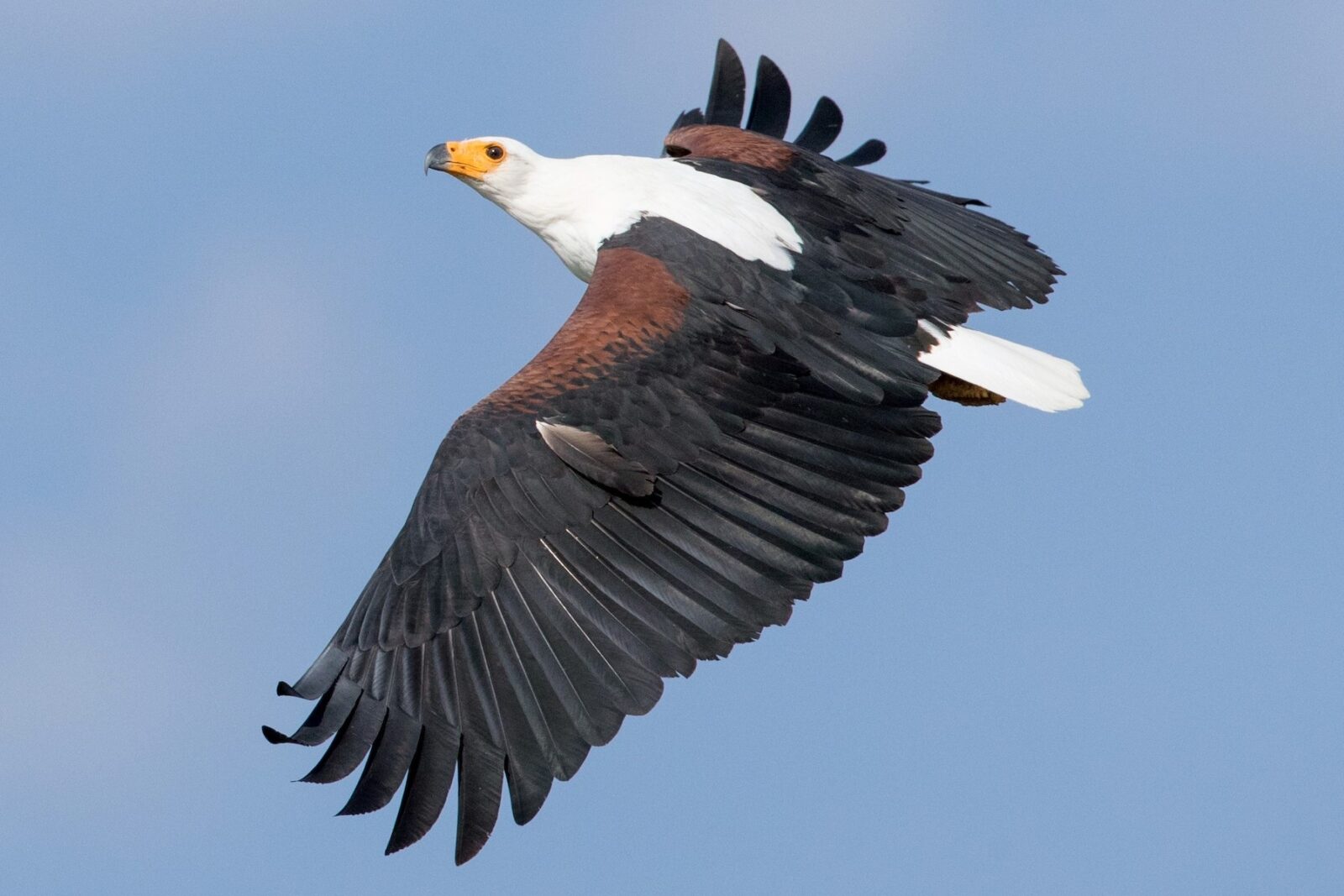
It is easily identified by its distinctive coloration. The head, chest, and tail are bright white, while the body and wings are rich brown. The hooked beak is yellow with a black tip, perfectly adapted for tearing flesh.
Its strong talons are designed for gripping slippery fish, making it highly specialized for its aquatic lifestyle.
In flight, the contrast between white and dark feathers is striking, making it easy to spot even from a distance.
Habitat: Where African Fish Eagles Live
The African Fish Eagle is found throughout sub-Saharan Africa, always in close proximity to water.
In Uganda, it is commonly seen in:
Lake Victoria, where it perches along shorelines and islands
Murchison Falls National Park, especially along the Nile River
Queen Elizabeth National Park, particularly around the Kazinga Channel
Lake Mburo National Park, where lakes and wetlands provide ideal hunting grounds
These habitats offer abundant fish and suitable trees for nesting and perching.
Hunting Behaviour: Precision and Power
The African Fish Eagle is a highly skilled hunter, relying on both vision and timing.
It typically hunts from a perch, watching the water below for movement. When it spots a fish near the surface, it launches into the air and glides toward the target.
At the right moment, it extends its talons and snatches the fish from the water in a single, fluid motion.
Unlike some birds, the African Fish Eagle does not fully submerge itself. Instead, it uses its strength to lift the fish from the surface and carry it to a perch for feeding.
Its diet mainly consists of fish, but it is also known to feed on:
Water birds
Carrion
Small mammals
This flexibility allows it to survive even when fish are less abundant.
Behaviour and Social Structure
African Fish Eagles are generally territorial and are often seen alone or in pairs.
Pairs form strong, long-term bonds and defend their territory aggressively against intruders. These territories are centered around reliable food sources, usually stretches of water.
The birds communicate through loud, distinctive calls, often performed as a duet between mates. This vocalization helps maintain territory and strengthen pair bonds.
They are also known for their characteristic upright posture while perched, scanning the environment with sharp eyesight.
Reproduction and Nesting
African Fish Eagles build large nests in tall trees near water. These nests are constructed from sticks and can be reused and expanded over many years.
Breeding pairs typically lay 1–3 eggs, with both parents involved in incubation and feeding.
Chicks grow rapidly and remain in the nest for several weeks before fledging. Parental care continues even after they begin to fly, ensuring higher survival rates.
Ecological Importance
As top predators in aquatic ecosystems, African Fish Eagles play an important role in maintaining ecological balance.
By feeding on fish and other animals, they help regulate populations and indicate the health of water systems.
Their presence is often a sign of a thriving ecosystem, making them an important species for conservation monitoring.
Best Time to See African Fish Eagles
African Fish Eagles can be seen year-round in Uganda and across much of Africa.
They are most active during early morning and late afternoon, when they hunt and call more frequently.
Boat safaris offer some of the best opportunities to observe them up close, especially along rivers and lakes.
Dry seasons often provide better visibility, but sightings are possible at any time due to their territorial nature.
Conservation Status
The African Fish Eagle is currently classified as Least Concern, with stable populations across much of its range.
However, it still faces threats from:
Water pollution
Overfishing
Habitat destruction
Protecting wetlands and freshwater ecosystems is essential for ensuring the long-term survival of this species.
Final Thoughts
The Haliaeetus vocifer is more than just a bird of prey—it is a symbol of Africa’s natural beauty and wild landscapes. Its powerful call, striking appearance, and mastery of the skies make it one of the most unforgettable sights on any safari.
Whether seen soaring above Lake Victoria or perched along the Nile in Murchison Falls National Park, the African Fish Eagle represents the spirit of Africa’s lakes and rivers.
For travelers, birdwatchers, and nature lovers, encountering this iconic species is not just a highlight—it is a defining moment of the African wilderness experience.