
Tree Hyrax: The Strange Elephant Relative of the Forest
Deep inside Uganda’s forests, especially in places like Bwindi Impenetrable National Park and other montane habitats, there is a small, unassuming mammal that most visitors never see but almost always hear. It produces a loud, eerie, almost human-like scream that echoes through the forest at night. Locals know it well. Guides recognize it instantly. But first-time safari visitors often assume it is a bird, a monkey, or even something supernatural.
This animal is the tree hyrax, one of Africa’s most unusual mammals and, surprisingly, one of the closest living relatives of elephants.
Despite its rabbit-like size and rodent-like appearance, the tree hyrax belongs to a lineage that connects it to some of the largest land animals on Earth. Understanding it properly requires shifting expectations away from appearance and toward evolutionary biology, behavior, and ecology.
What Exactly Is a Tree Hyrax?
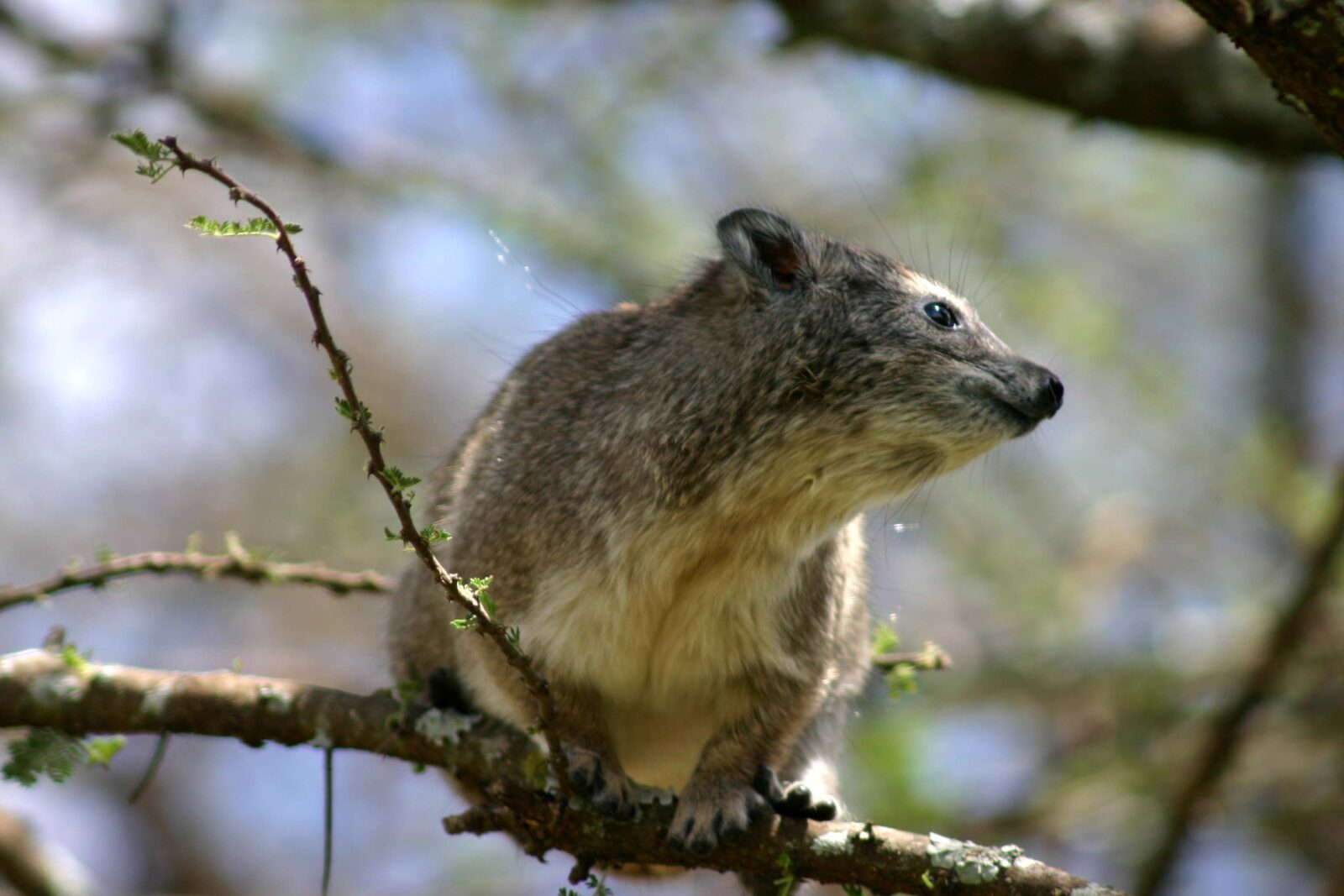
The tree hyrax is a small, arboreal mammal belonging to the order Hyracoidea. It lives primarily in forested and rocky environments across parts of East and Central Africa.
At first glance, it looks like a cross between a guinea pig and a small monkey. It has a compact body, short limbs, rounded ears, and a slightly teddy-bear-like appearance. But this superficial resemblance is misleading.
Genetically and anatomically, hyraxes are more closely related to elephants and manatees than to rodents or primates. This evolutionary connection is one of the most surprising facts in African wildlife biology.
Unlike elephants, however, tree hyraxes are small, secretive, and highly adapted to life in trees.
The Elephant Connection: A Hidden Evolutionary Link
One of the most fascinating aspects of the tree hyrax is its evolutionary relationship to elephants.
Although vastly different in size and appearance, hyraxes share anatomical and genetic traits with elephants. These include similarities in the structure of their feet, teeth development, and certain aspects of their skeletal formation.
This evolutionary link places hyraxes within a broader group of mammals known as Afrotheria, which includes elephants, manatees, aardvarks, and several other African-origin species.
What makes this connection particularly interesting is how dramatically evolution has shaped these animals in different directions. One lineage became the largest land mammal on Earth, while another remained small, agile, and forest-dwelling.
Where Tree Hyraxes Live
Tree hyraxes are primarily found in dense forest habitats, often in mountainous or high-altitude regions.
In Uganda, they are commonly associated with forested areas such as Bwindi Impenetrable National Park and other moist montane forests.
They prefer areas with thick vegetation, abundant climbing surfaces, and minimal disturbance. Unlike ground-dwelling hyrax species, tree hyraxes are adapted to arboreal life and are rarely seen on open ground.
They typically inhabit tree hollows, dense branches, or rocky crevices within forest ecosystems.
Nocturnal Lifestyle: Why You Rarely See Them
Tree hyraxes are mostly nocturnal or crepuscular, meaning they are active during nighttime and early morning hours.
During the day, they remain hidden in tree cavities or dense foliage, avoiding predators and conserving energy. At night, they emerge to feed and interact socially.
This nocturnal behavior is one of the main reasons they are rarely seen during daytime safaris, even in areas where they are relatively common.
Instead of visual sightings, most encounters with tree hyraxes are auditory.
The Famous Call: One of Africa’s Most Distinct Sounds
The most recognizable feature of the tree hyrax is its vocalization.
Their calls are loud, high-pitched, and often described as eerie or human-like. They can include screams, whistles, and wailing sounds that carry across long distances in forest environments.
To unfamiliar listeners, these calls can be confusing or even unsettling. However, within the ecosystem, they serve important communication functions.
Calls are used to mark territory, signal presence to other hyraxes, and maintain social structure within groups.
In forests like Bwindi, these vocalizations contribute significantly to the nighttime soundscape, alongside insects, frogs, and other nocturnal species.
Diet and Feeding Behavior
Tree hyraxes are herbivores. Their diet consists mainly of leaves, fruits, shoots, and other plant material.
They are selective feeders, often choosing tender vegetation that is easier to digest. Because of their slow metabolic rate, they do not require large quantities of food, which suits their low-energy lifestyle.
Feeding typically occurs at night when they are active and less vulnerable to predators.
Their ability to extract nutrients from fibrous plant material is supported by a specialized digestive system adapted for herbivory.
Social Structure: Solitary but Communicative
Tree hyraxes are generally considered semi-social. While they may live in loose groups, they are not highly gregarious like primates or ungulates.
Individuals often occupy overlapping territories, communicating through vocalizations rather than constant physical interaction.
Males are especially vocal, using calls to establish dominance and territorial boundaries.
Despite their limited physical interaction, auditory communication plays a central role in their social organization.
Predators and Survival Strategies
Tree hyraxes face predation from a variety of forest predators, including large birds of prey, snakes, and carnivorous mammals such as leopards.
Their primary defense strategies include remaining hidden, using dense canopy cover, and relying on silence and stillness during the day.
At night, their alertness increases, and their vocalizations may also serve as warning signals to other individuals.
Their arboreal lifestyle reduces ground-based predation risk, but they remain vulnerable when moving between trees or foraging.
Movement and Physical Adaptations
Tree hyraxes are not fast movers compared to many other mammals, but they are well adapted to climbing.
Their feet have specialized pads that provide grip on branches and rough surfaces. This allows them to move confidently within the canopy.
Their compact body structure helps maintain balance in elevated environments, while their relatively low body weight reduces strain on branches.
Despite these adaptations, they are not agile jumpers like monkeys. Their movement is more deliberate and cautious.
Role in the Ecosystem
Tree hyraxes play a subtle but important role in forest ecosystems.
As herbivores, they contribute to vegetation control by feeding on specific plant species. Their selective browsing can influence plant regeneration patterns in their habitat.
They also serve as prey for several predators, making them part of the forest food web.
Their presence indicates a healthy, undisturbed forest environment, particularly in montane ecosystems like Bwindi.
Why They Are Often Overlooked
Despite being relatively widespread in suitable habitats, tree hyraxes are rarely seen by tourists.
This is due to a combination of factors: nocturnal behavior, arboreal lifestyle, cryptic coloration, and preference for dense vegetation.
Even experienced guides may only encounter them indirectly through sound rather than sight.
As a result, they remain one of the least observed mammals in African forest safaris.
Cultural and Local Perceptions
In many local communities around Uganda’s forest regions, tree hyrax calls are well known.
The vocalizations are often interpreted in cultural contexts, sometimes associated with folklore or nighttime stories due to their unusual sound.
However, guides and conservationists recognize them as a normal and important part of the forest ecosystem.
The Forest’s Hidden Voice
The tree hyrax is one of the most overlooked mammals in Uganda’s forests, yet it plays a significant ecological and acoustic role in shaping the nighttime environment.
In places like Bwindi Impenetrable National Park, it contributes to the complex soundscape that defines the forest after dark, even when it remains invisible to visitors.
Its evolutionary connection to elephants adds a deeper layer of scientific intrigue, linking one of the smallest forest mammals to some of the largest land animals in existence.
Understanding the tree hyrax changes how the forest is perceived—not just as a place of visible wildlife, but as a layered environment filled with hidden species, subtle interactions, and continuous biological activity that extends far beyond what can be seen during a typical safari.