
Flamingo Migration to Lake Bogoria: When and Why It Happens
One of Africa’s Most Spectacular Movements
The sight of thousands—sometimes millions—of flamingos covering a soda lake in pink and white is one of the most iconic wildlife spectacles in East Africa. Among the most famous destinations for this phenomenon is Lake Bogoria in Kenya, where flamingo populations periodically gather in dramatic, shifting concentrations.
Unlike predictable migrations of large mammals such as wildebeest in the Serengeti ecosystem, flamingo movements are more irregular, highly sensitive to environmental conditions, and closely tied to water chemistry rather than seasonal rainfall alone.
Understanding why flamingos move to Lake Bogoria, when they arrive, and why they sometimes leave suddenly requires looking at ecology, food availability, and lake chemistry rather than simple migration calendars.
Where Lake Bogoria Fits in the Rift Valley System
Lake Bogoria is part of Kenya’s Rift Valley alkaline lake system, a chain of soda lakes that includes Lake Nakuru, Lake Elmenteita, and others. These lakes are characterized by high salinity and alkalinity, which create unique biological conditions.
Unlike freshwater lakes, soda lakes support limited biodiversity. However, they are ideal for certain microorganisms, especially cyanobacteria (blue-green algae), which form the foundation of the flamingo diet.
This makes lakes like Bogoria critical feeding grounds when conditions are optimal.
The Flamingo Species Involved
Two main flamingo species are associated with East African soda lakes:
The lesser flamingo, which is the primary species responsible for large pink congregations, and the greater flamingo, which appears in smaller numbers and is less tightly linked to soda lake systems.
The lesser flamingo is highly specialized, feeding almost exclusively on microscopic algae. This specialization is what drives its movement patterns and makes its distribution so dependent on water conditions.
Why Flamingos Move: The Role of Food, Not Seasons
Unlike many migratory birds that follow temperature or breeding cycles, flamingos move primarily in response to food availability.
Their main food source is Spirulina-like cyanobacteria that thrive in alkaline lakes. When these algae bloom in high concentrations, flamingos gather in massive numbers to feed.
When algae levels decline, increase in toxins occurs, or water chemistry changes, flamingos move to alternative lakes where conditions are more favorable.
This is why Lake Bogoria may be densely covered in flamingos at one time and almost empty at another.
What Triggers the Migration to Lake Bogoria
Flamingo presence at Lake Bogoria depends on a combination of ecological factors rather than a fixed seasonal schedule.
Key triggers include rising alkalinity levels that support algal growth, stable water temperatures that encourage cyanobacteria blooms, and reduced disturbance from flooding or dilution of lake chemistry.
When these conditions align, Lake Bogoria becomes a highly productive feeding ground, attracting large flamingo populations from across the Rift Valley.
However, if conditions shift even slightly, flamingos can relocate quickly to nearby lakes such as Lake Nakuru or Lake Elmenteita.
When Flamingos Are Most Likely to Be Seen
There is no guaranteed annual “migration season” for Lake Bogoria, but patterns tend to be influenced by regional rainfall cycles and lake chemistry fluctuations.
Periods following stable dry conditions often produce better algal blooms, which in turn attract more flamingos. Conversely, heavy rainfall can dilute lake salinity, disrupting food availability and causing birds to disperse.
Because of this variability, flamingo numbers at Lake Bogoria can change significantly within weeks.
The Lake Bogoria Environment
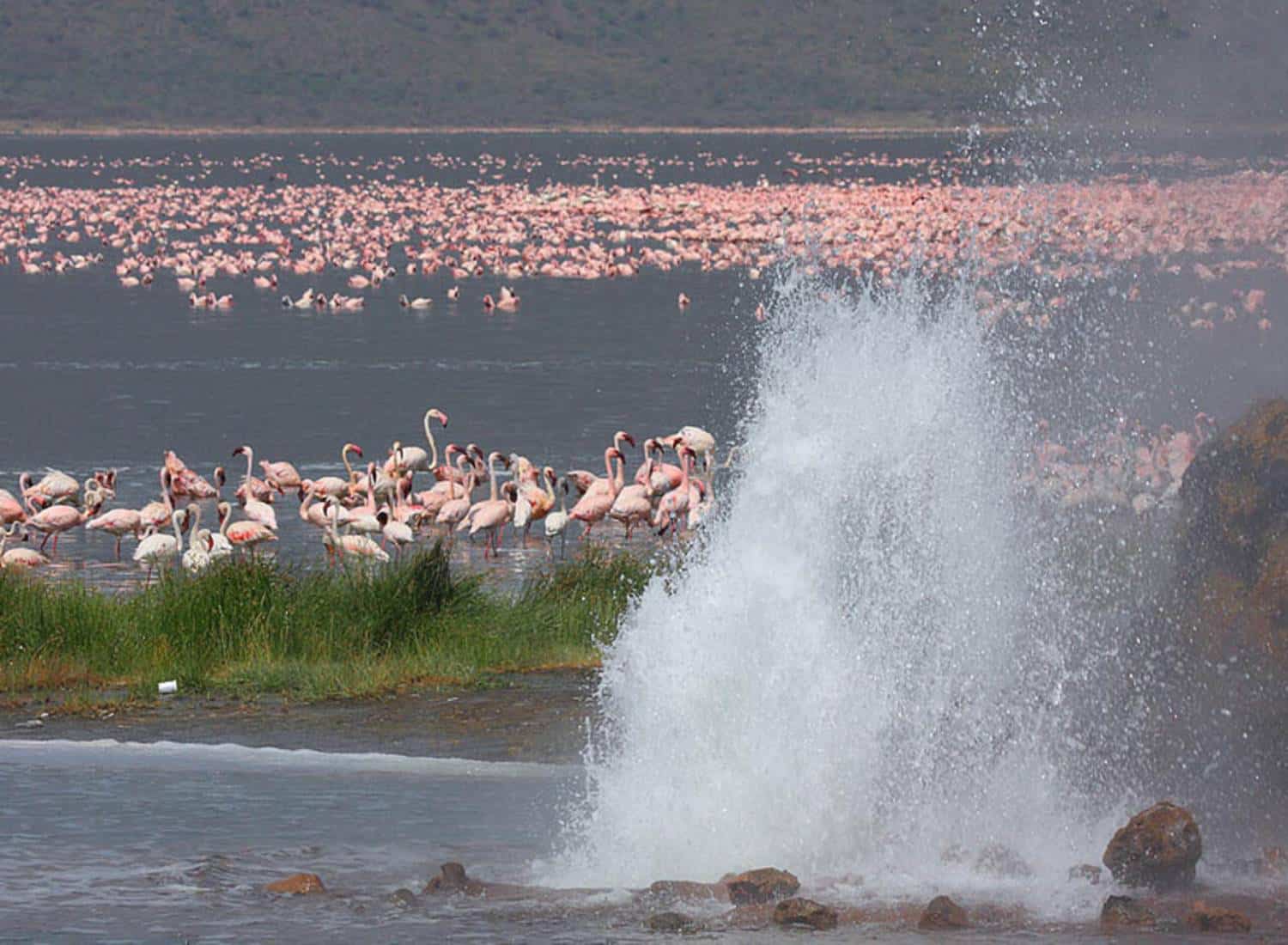
Lake Bogoria is a geothermal and alkaline lake surrounded by hot springs, geysers, and volcanic terrain.
These geothermal features contribute to the lake’s chemical composition, creating a harsh but biologically productive environment for algae growth.
The shoreline is often lined with salt deposits, and water levels can fluctuate seasonally. This dynamic environment plays a direct role in determining flamingo presence.
Feeding Behavior: Why Flamingos Gather in Huge Numbers
Flamingos feed by filtering water through specialized beaks designed to extract microscopic algae.
Because their food source is extremely small and distributed in dense patches, flamingos must gather in large numbers to efficiently exploit feeding zones.
This leads to the formation of massive flocks that can stretch across entire lake surfaces.
The visual effect is dramatic: a shifting, living carpet of pink that changes shape as birds move across feeding grounds.
Movement Between Rift Valley Lakes
Lake Bogoria is not an isolated destination in flamingo ecology. It is part of a broader network of soda lakes that flamingos move between depending on conditions.
Lakes such as Nakuru and Elmenteita often serve as alternative feeding sites when Bogoria is less productive, and vice versa.
This inter-lake movement means that flamingo “migration” is better understood as flexible regional redistribution rather than a single directional journey.
Why Flamingo Numbers Fluctuate Dramatically
One of the most confusing aspects for visitors is the sudden change in flamingo population size.
At times, Lake Bogoria may host hundreds of thousands of birds. At other times, only small groups may be present.
These fluctuations are driven by microscopic ecological changes. Even slight shifts in algae concentration, water salinity, or temperature can alter feeding suitability.
Because flamingos are highly mobile and responsive, they relocate quickly when conditions change.
Predators and Survival at the Lake
While flamingos are not heavily preyed upon at adult stage due to lake conditions, they are still vulnerable during certain life stages.
Shallow nesting areas can be affected by fluctuating water levels, and eggs or chicks may be exposed to predation or environmental stress.
However, the extreme alkalinity of soda lakes reduces the presence of many potential predators, making these environments relatively safe feeding grounds.
Tourism and Flamingo Viewing at Lake Bogoria
Lake Bogoria is one of the best places in East Africa to witness large flamingo gatherings when conditions are favorable.
Visitors often experience dramatic shoreline views where thousands of birds feed, move, and take flight in coordinated waves.
The geothermal landscape adds another layer of visual interest, with steam vents and hot springs visible near the lake edges.
However, because flamingo presence is not constant, timing is critical. Some visits may coincide with peak populations, while others may see only scattered flocks.
Ecological Sensitivity of the System
The flamingo ecosystem is highly sensitive to environmental change.
Climate variation, water inflow changes, pollution, and human activity can all affect algae production and lake chemistry.
This sensitivity makes flamingos important ecological indicators. Sudden changes in their distribution often reflect underlying environmental shifts in the Rift Valley lake system.
Conservation Considerations
Flamingo populations have experienced fluctuations over the years due to changes in water quality, habitat disturbance, and algal availability.
Conservation efforts focus on protecting lake ecosystems, monitoring water quality, and maintaining natural hydrological cycles.
Because flamingos depend on multiple interconnected lakes, conservation must be regional rather than site-specific.
A Migration Driven by Microscopic Life
The movement of flamingos to Lake Bogoria is not a traditional migration driven by distance or seasons, but a response to invisible ecological signals within the lake system.
Their presence depends on the abundance of microscopic algae, the chemical stability of alkaline waters, and the delicate balance of Rift Valley hydrology.
In places like Lake Bogoria, wildlife spectacle emerges not from large predators or herds, but from the accumulation of countless small biological interactions that shape where flamingos feed, rest, and move across the landscape.