
Mountain Bongo: East Africa’s Most Elusive Forest Antelope
The Antelope Most People Never See
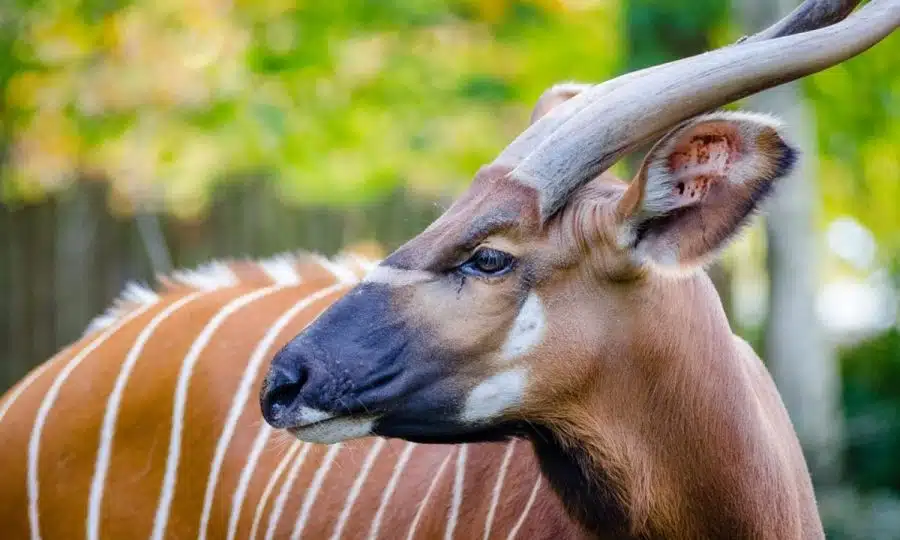
The mountain bongo is one of the rarest and most secretive antelopes in Africa. Even experienced safari guides can spend an entire career without seeing one in the wild. With its striking reddish-brown coat, bold white vertical stripes, and spiral horns, it looks almost artificially designed—yet it is entirely real and deeply adapted to dense forest life.
Unlike the more visible savannah antelopes seen in parks like Queen Elizabeth National Park or Murchison Falls National Park, the mountain bongo lives in thick, shadowed montane forests where visibility is limited and human encounters are extremely rare.
In East Africa, it is often described as a “ghost antelope,” not because it is mythical, but because it is so rarely observed directly in the wild.
Where Mountain Bongos Live
Mountain bongos are native to highland forest ecosystems in East Africa, primarily in Kenya’s central and western forest zones. Historically, their range may have extended into parts of Uganda, but today confirmed wild populations are extremely restricted.
They prefer dense, montane forests with thick undergrowth, abundant vegetation, and minimal human disturbance. These environments provide both food and cover, which are essential for a species that relies heavily on concealment.
Unlike open savannah species, bongos avoid exposed terrain entirely. Their survival strategy is based on remaining hidden rather than outrunning predators.
Why They Are So Rare
The mountain bongo is rare for several interconnected reasons.
First, it has a naturally low population density even in ideal habitat. Second, its habitat has been heavily reduced and fragmented by deforestation, agriculture, and human settlement expansion. Third, it is highly sensitive to disturbance, which limits its ability to survive near human activity.
Finally, hunting pressure in the past contributed significantly to population decline, especially due to its striking horns and meat value.
Today, remaining populations are small, fragmented, and closely monitored through conservation programs.
Physical Appearance: Built for the Forest
The mountain bongo is one of the most visually distinctive antelopes in Africa.
Its coat is a rich chestnut or reddish-brown color with vertical white stripes running along its body. These stripes are not decorative; they serve a functional purpose by breaking up the animal’s outline in dappled forest light, making it harder to detect in dense vegetation.
Both males and females have spiraled horns, though those of males are larger and more robust. The horns are used primarily for defense and dominance displays rather than frequent combat.
Its body is sturdy and muscular, built for navigating uneven forest terrain rather than speed across open plains.
Habitat: Life in the Dense Understory
Mountain bongos live in thick forest understories where visibility is often limited to a few meters.
In such environments, movement is slow and deliberate. Bongos rely on stealth and camouflage rather than speed to avoid predators.
They are most active during early morning and late afternoon, with periods of rest in dense cover during the day.
Their habitat preference makes them extremely difficult to study and even more difficult to observe in the wild.
Diet and Feeding Behavior
Bongos are herbivores with a highly varied diet. They feed on leaves, shoots, bark, fruits, and a wide range of forest vegetation.
They use their flexible lips and tongues to browse selectively, often feeding on plants that are not accessible to other herbivores.
Because forest food resources are scattered, bongos spend a significant amount of time moving slowly through their territory in search of suitable vegetation.
Their feeding behavior plays a subtle role in shaping forest plant dynamics by influencing which plant species are consumed and how vegetation regenerates.
Behavior: Solitary and Secretive
Mountain bongos are generally solitary or found in small groups, typically consisting of females and their offspring.
Adult males are often more solitary and may only join females during breeding periods.
This low social density is another factor that contributes to their rarity. Unlike herd-forming antelopes, bongos do not gather in large visible groups that are easy to spot during wildlife viewing.
Their behavior is quiet, cautious, and highly dependent on avoiding detection.
Predators and Survival Strategy
In their natural habitat, bongos face predation from leopards and, in some cases, other large carnivores.
Their primary defense is avoidance. They rely on dense vegetation, camouflage, and stillness to avoid detection.
When threatened, they prefer to flee into thick cover rather than engage in confrontation.
Calves are especially vulnerable, and maternal protection is critical during early life stages.
Conservation Status: A Species Under Pressure
The mountain bongo is classified as critically endangered in the wild.
Populations have declined significantly over time due to habitat loss, fragmentation, and historical hunting pressure.
Today, remaining wild populations are believed to be extremely small and localized, with much of the global population now found in managed conservation or semi-captive breeding programs.
Conservation efforts focus on habitat protection, breeding programs, and eventual reintroduction into secure forest reserves.
Can You See Mountain Bongo on Safari?
For most travelers, the answer is no.
Mountain bongos are not part of standard safari viewing experiences in East Africa. They are not reliably visible in national parks and are rarely encountered even in protected forest habitats.
Unlike gorilla trekking in Bwindi Impenetrable National Park, which offers structured and predictable wildlife encounters, bongo sightings in the wild are extremely uncommon.
Most knowledge about them comes from conservation centers, captive breeding facilities, and camera trap research rather than tourist safaris.
Captive and Conservation Viewing Opportunities
Some mountain bongos can be seen in specialized conservation centers and breeding facilities, primarily in Kenya.
These programs are designed to maintain genetic diversity and support potential future rewilding efforts.
However, even in these controlled environments, bongos are not commonly displayed to the public due to their sensitivity and conservation status.
This makes any direct viewing a rare and specialized experience rather than a typical safari activity.
Ecological Importance
Despite their rarity, mountain bongos play an important role in forest ecosystems.
As browsers, they help shape vegetation structure and contribute to plant diversity dynamics within their habitat.
Their presence also indicates healthy, intact forest systems, as they are highly sensitive to environmental disturbance.
Protecting bongos therefore also supports broader conservation goals for East African montane forests.
Misconceptions About Bongo Distribution
A common misconception is that bongos are widely distributed across East African forests. In reality, their range has become highly restricted, and many historical habitats no longer support stable populations.
Another misconception is that they are commonly seen on forest safaris. In practice, even guided forest walks rarely encounter them directly due to their extreme secrecy and low population density.
They are often better understood through indirect evidence such as tracks, droppings, or camera trap imagery rather than direct observation.
A Forest Ghost of East Africa
The mountain bongo represents one of the most elusive and least understood large mammals in East Africa. Its survival strategy is based on invisibility, silence, and deep adaptation to dense forest ecosystems.
While it shares the same geographic region as more accessible wildlife experiences in Uganda’s parks, it occupies a completely different ecological niche—one that prioritizes concealment over visibility.
In places like Bwindi Impenetrable National Park, travelers may encounter a wide range of forest biodiversity, but the mountain bongo remains largely outside the scope of typical safari observation.
It exists more as a conservation symbol and ecological indicator than as a regularly sighted safari animal, representing the hidden complexity of East Africa’s forest ecosystems.