
Bonobo: Congo’s Peaceful Cousin of the Chimpanzee
The “Forgotten Great Ape”
The bonobo is one of Africa’s least understood great apes, often overshadowed by its more aggressive relative, the common chimpanzee. Yet biologically, socially, and behaviorally, it is just as important in understanding human evolution.
Endemic only to the Democratic Republic of Congo, the bonobo represents a unique branch of the great ape family that evolved a distinctly different social system—one based less on dominance and aggression and more on cooperation, bonding, and social negotiation.
Unlike gorillas that can be seen in Uganda’s Bwindi Impenetrable National Park or chimpanzees in various East African forests, bonobos are not part of the East African safari experience. They are geographically restricted, and their habitat is difficult to access, which makes them one of the rarest apes for travelers to realistically encounter.
Where Bonobos Live
Bonobos are found exclusively south of the Congo River in the dense tropical rainforests of the Democratic Republic of Congo. This river acts as a natural geographic barrier that separated them from chimpanzees millions of years ago, leading to a completely different evolutionary path.
Their range is extremely limited compared to other great apes. They do not exist in Uganda, Rwanda, Kenya, or Tanzania. Instead, they are confined to lowland rainforest ecosystems that remain among the least explored in Africa.
Because of this isolation, most knowledge about bonobos comes from long-term scientific research sites rather than tourism-based encounters.
Evolutionary Relationship: Closest Cousins to Humans
Bonobos and chimpanzees share a common ancestor with humans, making them one of our closest living relatives.
What makes bonobos especially interesting is not just their genetic closeness, but the way their society evolved differently from chimpanzees despite similar ancestry.
While chimpanzees developed more hierarchical and sometimes aggressive social structures, bonobos evolved a more egalitarian system where social bonding plays a central role in conflict resolution.
This divergence provides valuable insight into how environment and geography can shape behavior in closely related species.
Social Structure: Female-Centered Societies
Bonobo society is famously matriarchal or female-centered. Females often form strong alliances that influence group dynamics and reduce male dominance.
Unlike chimpanzee groups where alpha males often control access to resources and mating opportunities, bonobo groups tend to distribute social power more evenly.
This does not mean males are unimportant, but rather that social stability is maintained through cooperation rather than force.
Conflict Resolution: “Make Peace, Not War”
One of the most well-known aspects of bonobo behavior is their use of social bonding to resolve tension.
Instead of escalating conflicts, bonobos often use grooming, play, and physical affection to reduce stress and restore group harmony.
This behavior is not random or purely emotional; it is a functional mechanism that maintains group cohesion in dense forest environments where cooperation is essential for survival.
Communication and Social Intelligence
Bonobos are highly intelligent and use a wide range of vocalizations, facial expressions, and gestures to communicate.
Their communication system is complex enough to manage group movement, food sharing, and social interactions without constant physical conflict.
They also demonstrate strong emotional intelligence, showing empathy, reassurance, and social awareness within their groups.
Diet and Feeding Behavior
Bonobos are primarily frugivores, meaning fruit makes up a large part of their diet. They also consume leaves, seeds, flowers, and occasionally small animals or insects.
Food sharing is an important social behavior among bonobos. Unlike more competitive species, feeding is often done in group settings with reduced aggression over resources.
This cooperative feeding behavior reinforces social bonds and reduces tension within groups.
Movement and Daily Life
Bonobos live in fission-fusion societies, meaning group size changes throughout the day depending on food availability and social needs.
They move through forest areas in flexible subgroups, often reuniting later in the day.
This flexible structure allows them to adapt efficiently to rainforest environments where food distribution is patchy and seasonal.
Sexual Behavior and Social Function
One of the most misunderstood aspects of bonobo behavior is their use of sexual interaction as a social tool.
In bonobo society, sexual behavior is not limited to reproduction. It is also used for conflict resolution, bonding, and social tension reduction.
This behavior plays a role in maintaining group harmony and reducing aggression, particularly in situations involving food competition or social stress.
From a biological perspective, it is a social mechanism rather than purely reproductive behavior.
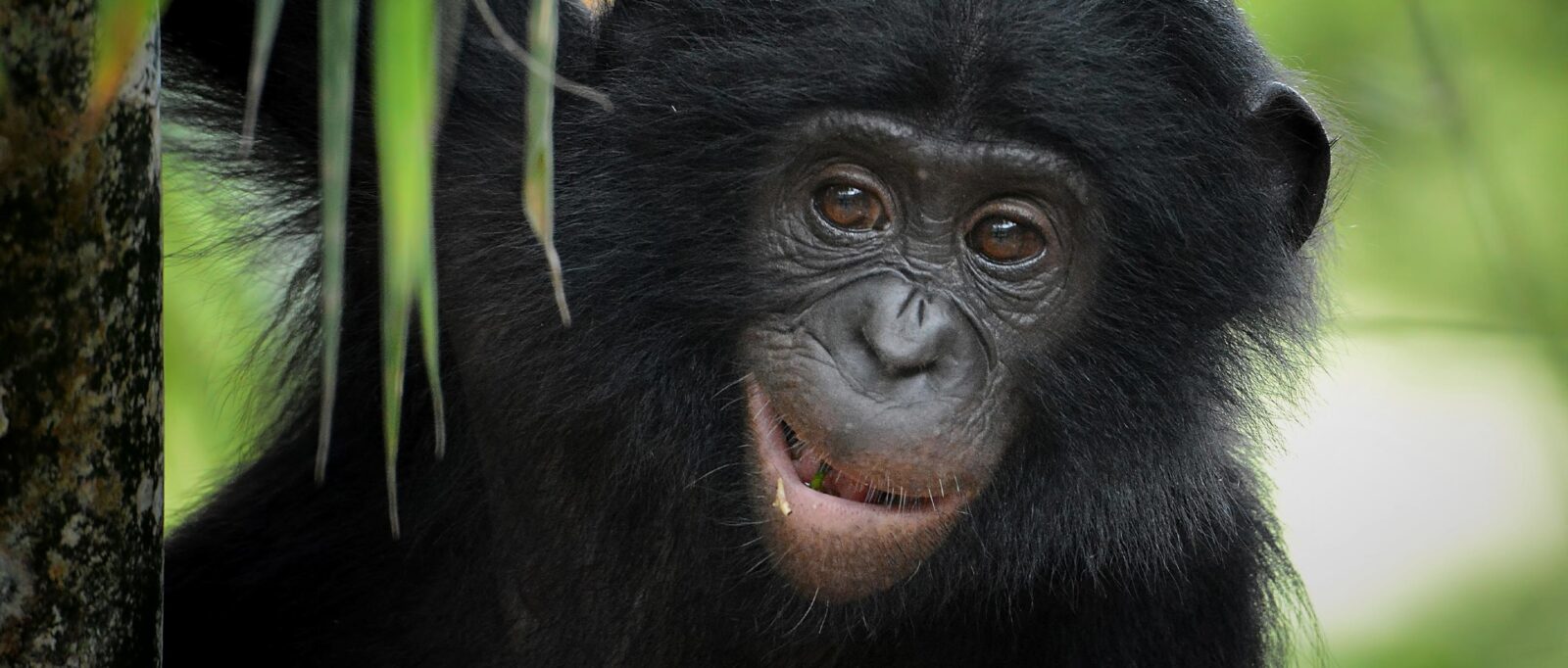
Comparison with Chimpanzees
Chimpanzees, found in various parts of Africa including some East African forest regions, tend to have more hierarchical and sometimes aggressive social structures.
Bonobos, by contrast, emphasize cooperation, reduced aggression, and stronger female influence in group dynamics.
Both species are equally intelligent and socially complex, but they represent two different evolutionary strategies for surviving in similar environments.
Habitat and Conservation Challenges
Bonobos are classified as endangered due to habitat loss, hunting, and political instability in their limited range.
Their habitat is primarily lowland rainforest, which is increasingly threatened by logging, agriculture, and human settlement expansion.
Conservation efforts are focused on protecting remaining forest blocks and supporting local communities to reduce hunting pressure.
Unlike gorillas in Uganda’s tourism-supported systems, bonobo conservation relies more heavily on research funding and international conservation programs.
Can Tourists See Bonobos?
For most safari travelers, bonobos are not a realistic wildlife encounter.
There is no established tourism circuit for bonobos comparable to gorilla trekking in East Africa. Access to their habitat is logistically difficult and often requires specialized expedition planning.
A small number of controlled research or sanctuary-based viewing opportunities exist in the Democratic Republic of Congo, but these are limited and not part of mainstream safari itineraries.
This makes bonobos one of the least accessible great apes for global travelers.
Why Bonobos Matter for Conservation Science
Bonobos are critical for understanding human evolution and social behavior.
Their peaceful social structures challenge assumptions about aggression being the default evolutionary strategy among great apes.
Studying bonobos provides insight into alternative models of social organization, cooperation, and conflict resolution in primates closely related to humans.
They also serve as indicators of forest ecosystem health in the Congo Basin, one of the most important carbon-storing ecosystems in the world.
Misconceptions About Bonobos
One common misconception is that bonobos are simply “peaceful chimpanzees.” In reality, they are a distinct species with unique evolutionary history and behavioral adaptations.
Another misconception is that they are widely distributed across Africa. In fact, their range is extremely limited to specific regions of the Congo Basin.
They are also sometimes assumed to be commonly observable in African safaris, which is not the case. Unlike species encountered in parks such as Bwindi Impenetrable National Park, bonobos are not part of standard East African wildlife viewing.
A Species Shaped by Isolation
The bonobo represents one of the most remarkable examples of how geography can shape evolution. Isolated south of the Congo River, they developed a social system that prioritizes cooperation over dominance and bonding over aggression.
While they remain largely inaccessible to mainstream safari tourism, their significance extends far beyond visibility. They offer a different lens through which to understand primate behavior, forest ecology, and the evolutionary pathways that ultimately connect humans to the broader ape family.
In the broader context of African wildlife, bonobos stand as a reminder that some of the most important species are not always the most visible ones, but those that quietly shape scientific understanding from the depths of remote forests.