
The Great Migration in Tanzania: Month-by-Month Guide
The Great Migration is one of the most complex and continuously moving wildlife systems on the planet. It is not a single event, but a year-round circular movement of more than a million wildebeest, accompanied by hundreds of thousands of zebras and gazelles. This movement is driven entirely by rainfall and fresh grazing patterns across the Serengeti ecosystem.
At the center of this ecosystem is Serengeti National Park, a vast protected landscape where wildlife movement still follows ancient natural rhythms. The migration also extends into the Ngorongoro Conservation Area, forming a continuous ecological circuit that spans thousands of square kilometers.
Understanding the migration month by month is essential for planning a safari, because the experience changes completely depending on timing. Some months offer dramatic river crossings, others focus on calving and predator action, while others provide quiet solitude and vast herds spread across open plains.
This guide breaks down the full annual cycle in detail so you can understand where the herds are at any time of year and what kind of safari experience to expect.
January: Southern Plains Concentration and Early Grazing Stability
In January, the herds are concentrated in the southern Serengeti and the short-grass plains around Ndutu. This region offers nutrient-rich grazing that supports pregnant females preparing for calving. The landscape is open, green, and highly photogenic, with excellent visibility across wide plains.
Wildlife density is extremely high during this period. Wildebeest and zebra move in massive mixed herds, often stretching to the horizon. Predator presence is already significant, with lions, cheetahs, and hyenas closely monitoring movement patterns. Although large-scale hunting scenes are not at their peak yet, tension is building in the ecosystem as calving season approaches.
January is often considered a transitional preparation month. The herds are not yet under peak predation pressure, but the ecological conditions are setting the stage for one of the most dramatic wildlife events on Earth.
February: Peak Calving Season and Predator Intensity
February is one of the most important months in the entire migration cycle. This is when the majority of wildebeest calves are born within a short window of a few weeks. The southern plains become a massive nursery, with hundreds of thousands of newborn calves entering the ecosystem almost simultaneously.
This synchronized birth strategy is a survival adaptation. By overwhelming predators with sheer numbers, individual calf survival rates increase. However, predator activity is also at its highest intensity during this period. Lions take advantage of vulnerable targets, cheetahs utilize speed across open plains, and hyenas patrol continuously in coordinated clans.
The Ndutu region becomes one of the most active wildlife zones in Africa. Interaction density between predator and prey is extremely high, making February one of the most sought-after months for photographic safaris.
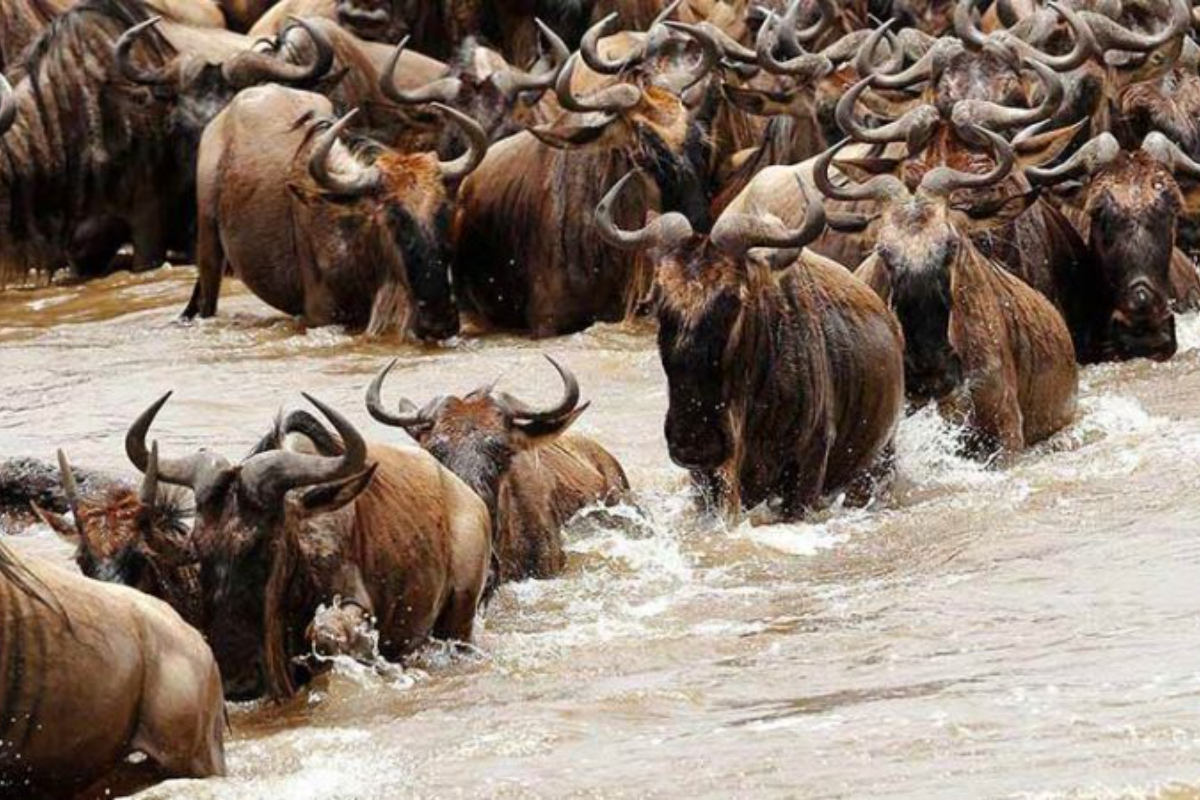
March: Late Calving and Increasing Environmental Pressure
By March, calving activity begins to taper off, although many young calves are still present. The herds remain concentrated in the southern plains, continuing to graze intensively as they build strength for the next phase of migration.
Weather conditions begin to shift. Clouds become more frequent, and the first signs of the long rains appear. These environmental changes gradually influence movement patterns, although the herds remain in the south for most of the month.
Predator activity continues, but the focus begins to shift from newborn calves to slightly older and more mobile juveniles. The ecosystem remains highly active but begins to show early signs of dispersal.
April: Long Rains and Early Northward Movement
April marks the peak of the long rainy season. Heavy rainfall transforms the southern plains into a lush green environment, but also makes movement more difficult in some areas. The herds begin a gradual northward shift as grazing conditions change.
Unlike dramatic migrations seen in documentaries, this movement is slow and fluid. The herds do not move as a single mass but rather in loosely connected groups following rainfall gradients.
Wildlife viewing in April can be more challenging due to dispersal and vegetation density. However, the landscape is at its most vibrant and green, and visitor numbers are low, creating a quiet and immersive safari experience for those who travel during this period.
May: Transition Through Central Corridors
In May, the migration becomes more structured as herds move through central Serengeti corridors. Rainfall begins to decrease, and grazing pressure in the south increases as fresh grass becomes scarcer.
Large groups of wildebeest and zebra start forming directional movement patterns toward the western and northern regions. This is not yet a dramatic crossing phase but rather a steady relocation process driven by food availability.
Predator-prey interactions continue, but they are more dispersed compared to the concentrated action of earlier months.
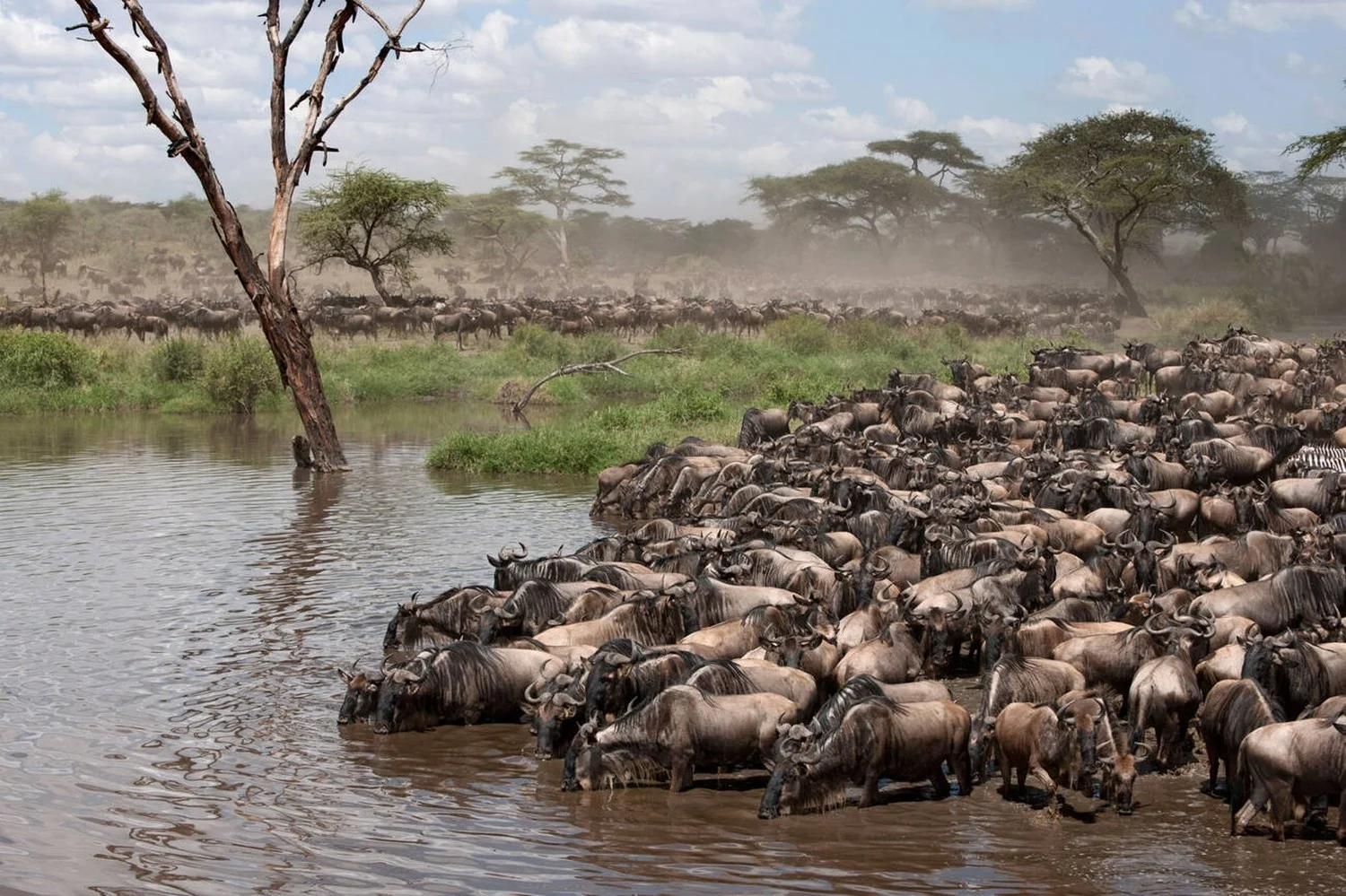
June: Western Corridor and Early Grumeti River Encounters
June marks a significant shift in migration behavior. The herds enter the western Serengeti corridor, approaching the Grumeti River system. This area introduces one of the first major natural obstacles of the migration cycle.
The Grumeti River is known for its resident crocodile populations, and early crossings begin to occur depending on water levels. While not as famous as the later Mara River crossings, these events are still dramatic and unpredictable.
Vegetation is thinning, and the dry season begins to establish itself, improving overall visibility for game viewing.
July: Western to Northern Movement Intensifies
July is one of the most dynamic months of the migration. Herds continue moving from the western corridor toward the northern Serengeti. This is the beginning of the peak dry season, and animals are increasingly concentrated along remaining water sources.
River crossings become more frequent and intense as herds approach the northern ecosystems. Predator activity increases significantly, especially near water points and crossing zones.
This is also the beginning of peak safari season in Tanzania due to excellent visibility and concentrated wildlife.
August: Mara River Crossings Begin
August is widely recognized as one of the most dramatic months of the migration. Herds gather near the Mara River, preparing for dangerous crossings into Kenya’s Maasai Mara ecosystem.
Crossings are highly unpredictable. Thousands of animals may gather at riverbanks for hours before suddenly rushing into the water. Crocodiles lie in wait, and stampedes are common. These moments define the migration’s global reputation.
Not all crossings occur daily, and patience is essential for safari travelers during this period.
September: Continued River Crossings and Northern Grazing
In September, migration activity continues in the northern Serengeti and Maasai Mara border regions. River crossings still occur, but herds also begin to spread into grazing territories after successfully crossing.
Wildlife viewing remains exceptional, with large concentrations of herbivores and predators following closely behind.
October: Gradual Return South Begins
By October, grazing conditions in the north begin to decline. The herds slowly start moving back toward the central Serengeti in response to changing rainfall patterns.
This return journey is less dramatic than the northward push but still involves significant movement and predator interaction.
November: Short Rains and Reorganization
November marks the beginning of the short rains. The ecosystem becomes more dynamic again as fresh grass emerges in southern regions. Herds begin reassembling and reorganizing for the return to the southern plains.
Movement becomes less linear and more scattered as animals respond to localized rainfall.
December: Return to Southern Plains
By December, the migration completes its annual cycle as herds return to the southern Serengeti and Ndutu plains. This sets the stage for the next calving season.
The landscape becomes green again, and wildlife density increases significantly. Predator presence rises as the ecosystem resets for another cycle.
Final Overview
The Great Migration is not a single event but a continuous ecological loop driven by rainfall and survival instincts. Every month offers a different version of the story, from calving season in the south to river crossings in the north and transitional movement in between.
For safari planning, the key is not asking when the migration happens, but rather which phase of the migration you want to experience.