
Nairobi National Park: Safari Minutes from the City Centre
A Safari That Begins at the Edge of a Capital City
Just a short drive from the heart of Nairobi sits one of the most surprising wildlife spaces in the world—Nairobi National Park. It is one of those rare places where the boundary between wilderness and urban life feels almost blurred. One moment you are in traffic, surrounded by tall buildings and the rhythm of a modern African capital, and the next you are rolling into open savannah where giraffes move slowly across the horizon and the soundscape shifts to birds, wind, and distant animal calls.
What makes this park unforgettable is not just the wildlife, but the contrast. Few places on earth allow you to watch lions resting in golden grasslands while skyscrapers stand in the background. It is a visual reminder that nature and human development are not always separated by distance—sometimes they exist side by side.
The Story Behind the Park
Nairobi National Park was established in 1946, making it Kenya’s first national park. At the time, the idea of setting aside protected land so close to a growing city was forward-thinking, even controversial. But it proved to be one of the most important conservation decisions in the country’s history.
As Nairobi expanded over the decades, the park remained in place, becoming a critical refuge for wildlife in an increasingly urbanized region. Today, it stands as a symbol of early conservation planning and continues to play a vital role in protecting species that would otherwise have far less space to roam.
Unlike many other protected areas that are far from human settlement, this park exists within a living, growing city. That reality has shaped everything about it—from how wildlife moves, to how conservation is managed, to how visitors experience it.
The Landscape: Simple, Open, and Wild
At first glance, Nairobi National Park may look understated compared to larger, more dramatic reserves. But its simplicity is part of its strength. The terrain is mostly open grassland, broken by scattered acacia trees, rocky ridges, and seasonal rivers that shape the movement of animals throughout the year.
This openness makes wildlife easier to spot, especially for visitors on a short safari. There are no dense forests blocking your view, no long drives through thick vegetation. Instead, animals appear across wide horizons, often silhouetted against the morning or evening light.
The southern boundary of the park remains open, allowing natural movement of wildlife in and out of the ecosystem. This is especially important for larger herbivores that depend on seasonal grazing patterns outside the park.
Wildlife in a Unique Urban Wilderness
Despite its size and location, Nairobi National Park supports an impressive diversity of animals. It is one of the few places where you can encounter four of the Big Five within such close proximity to a capital city.
Lions are among the most iconic residents. They are often seen resting in the grass during the day, conserving energy for nighttime activity. Early mornings and late afternoons offer the best chance to see them more active, especially when temperatures are cooler.
Leopards exist in the park but are rarely seen due to their secretive nature. They prefer dense cover and are experts at staying out of sight. Their presence, however, is a reminder of how intact the ecosystem still is despite urban pressure.
Cheetahs are more visible in open areas, where they rely on speed and long sightlines to hunt. Watching a cheetah move across the plains with the city skyline in the distance is one of those moments that stays with visitors long after they leave.
Perhaps most important is the presence of black rhinos. The park has become a key sanctuary for them, helping to protect a species that has faced severe threats from poaching across Africa. Seeing a rhino moving slowly through the grasslands is not just a safari highlight—it is a conservation success story in action.
Beyond the predators, the park is home to zebras, giraffes, buffaloes, antelopes, and a wide range of birdlife. Over 400 bird species have been recorded, making it a strong destination for birdwatching as well.
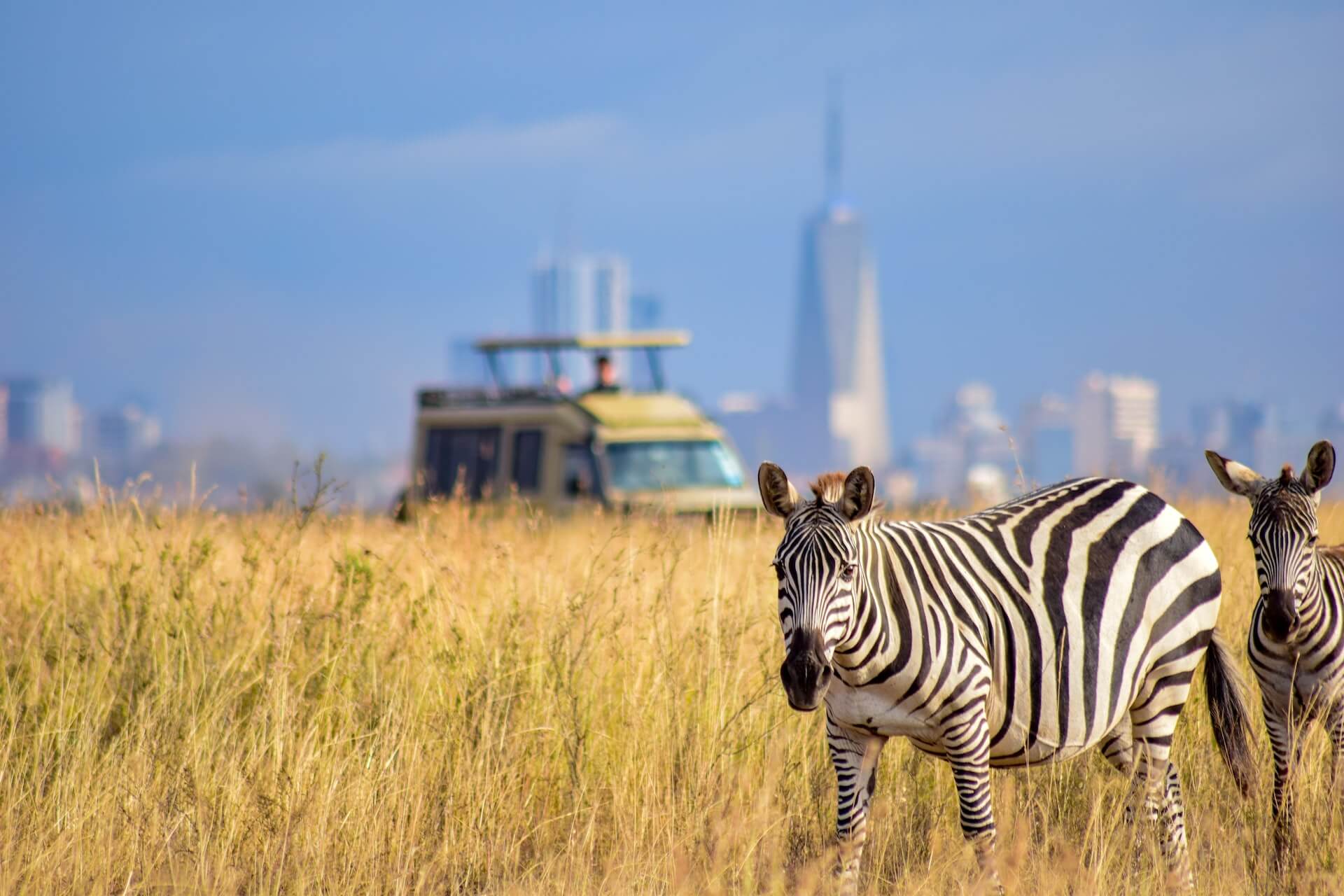
The Skyline Effect: Nature Meets City
One of the defining features of Nairobi National Park is what many visitors come to see: the skyline backdrop. Few safari destinations offer this visual combination of wildlife and city architecture in the same frame.
On clear days, especially in the early morning, you can watch giraffes or buffalo moving across the plains with the modern silhouette of Nairobi rising in the background. It is a contrast that feels almost surreal—nature continuing its rhythm while a major city operates just beyond the park boundary.
This is not just a photographic novelty. It also reflects a deeper reality: the park exists within a human-dominated landscape, and its survival depends on careful balance between development and conservation.
Conservation Challenges and Urban Pressure
Being so close to a major city brings both advantages and challenges. On one hand, the park is highly accessible, well-known, and easier to manage in terms of tourism infrastructure. On the other hand, urban expansion constantly puts pressure on its boundaries.
One of the most significant issues is habitat fragmentation. Roads, settlements, and infrastructure developments around Nairobi can disrupt wildlife movement patterns, especially for migratory species that rely on seasonal grazing outside the park.
Human-wildlife conflict is another ongoing concern. As the city grows closer, interactions between wildlife and surrounding communities require careful management to ensure both safety and ecological balance.
Despite these challenges, conservation efforts remain active and adaptive. Wildlife monitoring, anti-poaching patrols, and community engagement programs all play a role in keeping the ecosystem functional.
Visitor Experience: A Short Drive Into Another World
What makes Nairobi National Park especially appealing is how easy it is to visit. You do not need a long journey or complex travel arrangements. A simple drive from the city centre takes you directly into the park, often within less than an hour.
This makes it ideal for short stays, layovers, or travelers who may not have time to visit Kenya’s more remote parks. Morning game drives are particularly popular, as animals are more active and the lighting conditions are perfect for photography.
Even a half-day visit can feel complete. In just a few hours, you can experience lions, rhinos, giraffes, and wide open landscapes without leaving the metropolitan area behind for long.
Why Nairobi National Park Feels Different
What sets this park apart is not only what you see, but how you experience it. There is something powerful about watching wildlife in such close proximity to human civilization. It challenges expectations of what a safari should look like.
Instead of total isolation, you get contrast. Instead of remoteness, you get immediacy. And instead of leaving the city behind for days, you step into the wild almost effortlessly.
For many visitors, this creates a deeper appreciation for conservation. It becomes clear that wildlife does not only exist in distant, untouched places—it also survives in shared landscapes that require careful balance and protection.
Final Reflection
Nairobi National Park is more than just a tourist destination. It is a living example of coexistence between a growing city and a functioning ecosystem. It tells a story of conservation under pressure, of adaptation, and of the ongoing effort to preserve wild spaces in unexpected places.
Whether you are a first-time visitor or a seasoned safari traveler, the experience remains unique. Few places in the world allow you to stand in the wild and still see the outlines of a capital city beyond the horizon.