
Mount Kenya National Park: Trekking Africa’s Second Highest Peak
Mount Kenya National Park offers one of Africa’s most rewarding high-altitude trekking experiences, centered around Mount Kenya—the continent’s second-highest peak after Kilimanjaro. Rising to 5,199 meters (17,057 ft), Mount Kenya is not just a mountain; it is a dramatic volcanic massif with jagged summits, glacial valleys, alpine lakes, and unique vegetation zones that shift dramatically with altitude.
While Kenya is globally known for its wildlife safaris, Mount Kenya introduces a completely different dimension—one of physical challenge, scenic diversity, and ecological richness. For trekkers and adventure travelers, it represents a quieter, less crowded alternative to Mount Kilimanjaro, yet equally captivating in its own right.
Geography and Geological Formation
Mount Kenya is an extinct stratovolcano formed millions of years ago, now eroded into a rugged and complex mountain landscape. Its highest peaks—Batian and Nelion—are technical climbing summits, while Point Lenana (4,985 meters) is the most accessible trekking peak.
The mountain lies almost directly on the equator, yet its high altitude creates a range of climatic zones, from tropical forest at the base to glaciers near the summit. These zones are clearly defined and create a layered trekking experience unlike any other in Africa.
Glacial valleys carve through the mountain, and tarns (small mountain lakes) reflect the surrounding peaks, adding to the visual appeal.
Trekking Routes: Choosing Your Path
There are several established routes on Mount Kenya, each offering a different experience in terms of scenery, difficulty, and acclimatization.
Sirimon Route
The Sirimon route approaches from the northwest and is considered one of the most scenic and gradual ascent options. It passes through forest, moorland, and alpine zones, making it ideal for acclimatization.
Chogoria Route
Often regarded as the most beautiful route, Chogoria features dramatic landscapes including waterfalls, gorges, and Lake Michaelson. It is slightly more demanding but visually rewarding.
Naro Moru Route
The fastest and most direct route, Naro Moru is popular but steeper and less scenic. It is often used for descent or for trekkers with limited time.
Combining routes—such as ascending via Sirimon and descending via Chogoria—is a common strategy to maximize scenery and acclimatization.
Vegetation Zones: A Botanical Journey
One of the most fascinating aspects of trekking in Mount Kenya National Park is the progression through distinct ecological zones.
- Montane Forest (up to ~3,000m): Dense forest with bamboo, cedar, and wildlife such as monkeys and elephants
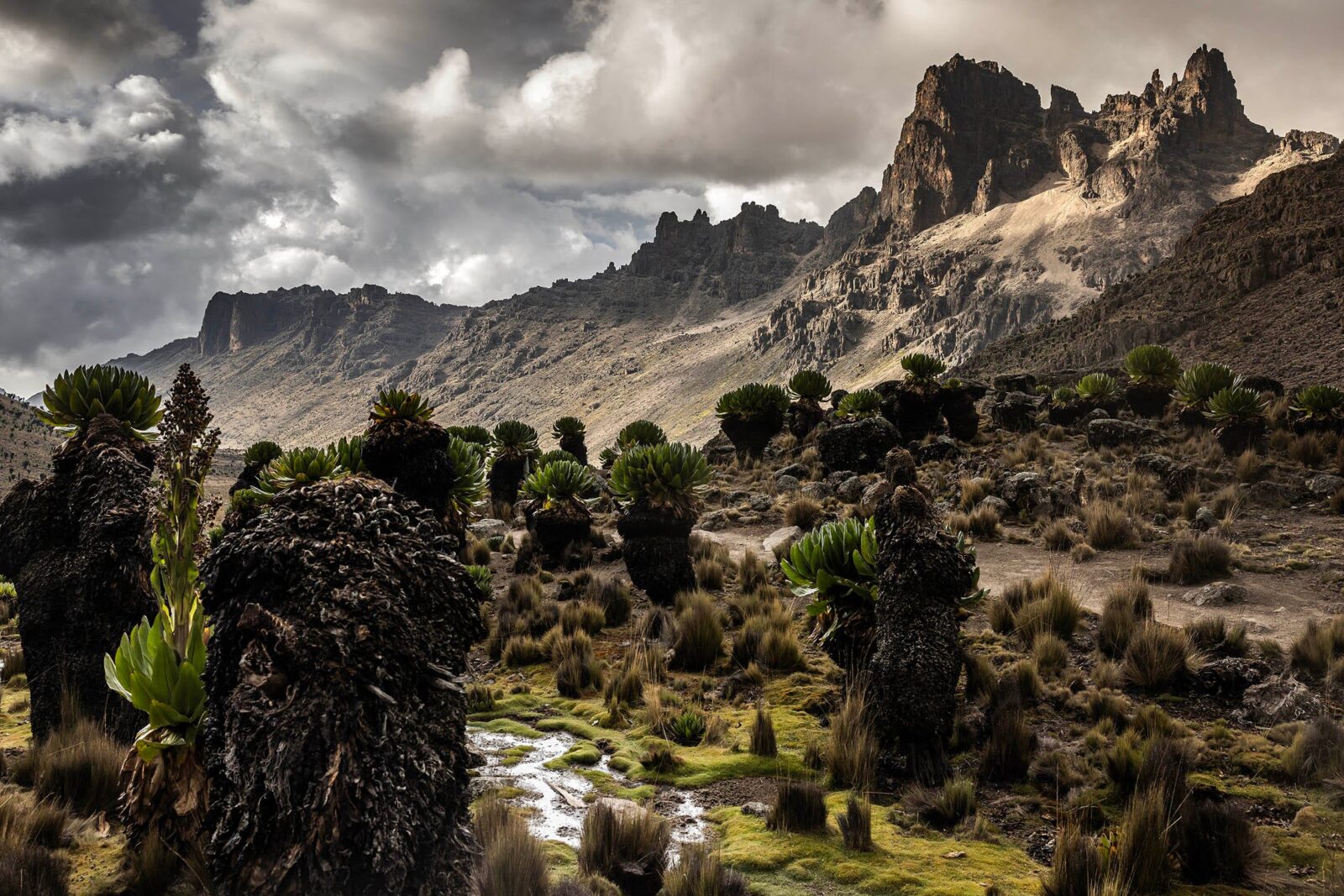
- Moorland (3,000–4,000m): Open landscapes with giant heathers and lobelias
- Alpine Zone (above 4,000m): Sparse vegetation, rocky terrain, and dramatic views
- Glacial Zone: Ice, snow, and exposed rock near the peaks
This vertical diversity creates a trekking experience that feels like traveling through multiple ecosystems in a single journey.
Wildlife Encounters on the Mountain
Although trekking is the primary focus, Mount Kenya National Park is also a wildlife conservation area.
The lower forest zones are home to elephants, buffaloes, colobus monkeys, and various antelope species. While sightings are less predictable than in traditional safari parks, they add an element of surprise to the trek.
Birdlife is abundant, particularly in the forest and moorland zones, with species adapted to different altitudes.
The Summit Experience: Point Lenana
For most trekkers, the goal is Point Lenana, the third-highest peak of Mount Kenya. Reaching it does not require technical climbing skills, making it accessible to fit and prepared hikers.
Summit attempts typically begin before dawn, allowing trekkers to reach the top at sunrise. The view from Point Lenana is one of the most spectacular in Africa—glaciers, valleys, and distant plains illuminated by early morning light.
On clear days, it is even possible to see Mount Kilimanjaro on the horizon.
Difficulty and Acclimatization
Trekking Mount Kenya is physically demanding and requires proper acclimatization. Altitude sickness is a real risk, and itineraries are designed to allow gradual ascent.
Most treks last 4 to 6 days, providing sufficient time to adapt. Fitness is important, but pacing and hydration are equally critical.
Compared to Kilimanjaro, Mount Kenya is often considered less crowded and more varied, but still challenging.
Best Time to Trek Mount Kenya
The best times to trek Mount Kenya are during the dry seasons:
- January to March
- June to October
During these periods, weather conditions are more stable, and visibility is generally better. Rainy seasons can make trails slippery and reduce visibility, though the landscapes become greener.
Accommodation and Trekking Logistics
Accommodation on Mount Kenya ranges from mountain huts to camping. Popular huts include those along the Sirimon and Naro Moru routes, while the Chogoria route often involves camping.
Treks are typically organized with guides, porters, and cooks, ensuring safety and logistical support. This also contributes to local employment and conservation efforts.
Why Choose Mount Kenya Over Kilimanjaro?
While Mount Kilimanjaro is more famous, Mount Kenya offers several advantages:
- Fewer crowds and a more peaceful experience
- Greater scenic diversity
- Technical climbing options for advanced climbers
- Richer ecological variation
It is particularly appealing to travelers seeking a more authentic and less commercialized trekking experience.
Conservation and UNESCO Status
Mount Kenya National Park is a UNESCO World Heritage Site, recognized for its ecological and geological significance. Conservation efforts focus on protecting its unique ecosystems, water catchment areas, and wildlife.
The mountain plays a crucial role in Kenya’s water supply, feeding rivers that support agriculture and communities downstream.
A Trek Worth Taking
Mount Kenya is more than a climb—it is a journey through ecosystems, landscapes, and personal limits. From dense forests to icy peaks, every stage of the trek offers something new and unforgettable.
For those willing to take on the challenge, Mount Kenya National Park delivers an experience that rivals the best trekking destinations in the world—without the crowds and with a deeper sense of discovery.
In the end, reaching the summit is only part of the reward. The true value lies in the journey itself.