
Gombe Stream National Park: Where Jane Goodall Studied Chimps
On the quiet, forested shores of Lake Tanganyika lies one of Africa’s most intimate and historically profound wildlife destinations — Gombe Stream National Park. Unlike the sweeping savannahs that define much of East Africa’s safari image, Gombe is small, steep, and deeply personal. It is a place where the wilderness feels close, where every footstep matters, and where the story of human understanding of primates was forever changed by the work of Jane Goodall.
To visit Gombe is not simply to go on safari. It is to step into a living laboratory of nature, a place where science, conservation, and raw wilderness intersect in a way that is both humbling and unforgettable.
The Birthplace of Modern Primate Research
In 1960, a young Jane Goodall arrived on the shores of Lake Tanganyika with little more than curiosity, patience, and a determination to understand chimpanzees in the wild. At the time, the scientific world knew very little about these animals. What followed in Gombe would redefine our understanding of primates — and ourselves.
Through months of careful observation, Goodall made discoveries that challenged long-held beliefs. She witnessed chimpanzees crafting and using tools, stripping leaves from twigs to extract termites. This single observation shattered the assumption that tool use was uniquely human. Over time, she documented their social bonds, emotional depth, and complex behaviors — from nurturing care within families to territorial conflicts between groups.
Her work in Gombe Stream National Park transformed primatology and inspired a global movement for wildlife conservation. Today, decades later, the research continues, making Gombe one of the longest-running field study sites in the world.
A Landscape of Forest and Water
Gombe’s physical beauty is as striking as its scientific importance. The park is set along the eastern edge of the Great Rift Valley, where forested ridges rise sharply from the clear blue waters of Lake Tanganyika. Despite being one of Tanzania’s smallest national parks, its terrain is remarkably diverse.
The forest canopy is dense and alive with sound — birds calling from above, leaves rustling with unseen movement, and the occasional distant call of chimpanzees echoing through the valleys. Trails cut through steep slopes and narrow valleys, sometimes opening onto clearings that reveal breathtaking views of the lake below.
Unlike the open plains of parks like the Serengeti, Gombe is enclosed, intimate, and immersive. There are no roads for game drives here. Every experience is on foot, which means every encounter feels immediate and real.
Chimpanzee Trekking: A Journey Into Their World
Chimpanzee trekking in Gombe is one of the most immersive wildlife experiences in Africa. Unlike viewing animals from a vehicle, here you move through the forest as a participant, guided by trackers who understand the movements and behaviors of the chimpanzee groups.
The trek begins early in the morning, often with the sounds of the forest slowly awakening. Depending on the location of the chimpanzees, the hike can be short or physically demanding, involving steep climbs and careful navigation through dense vegetation. But the anticipation builds with every step.
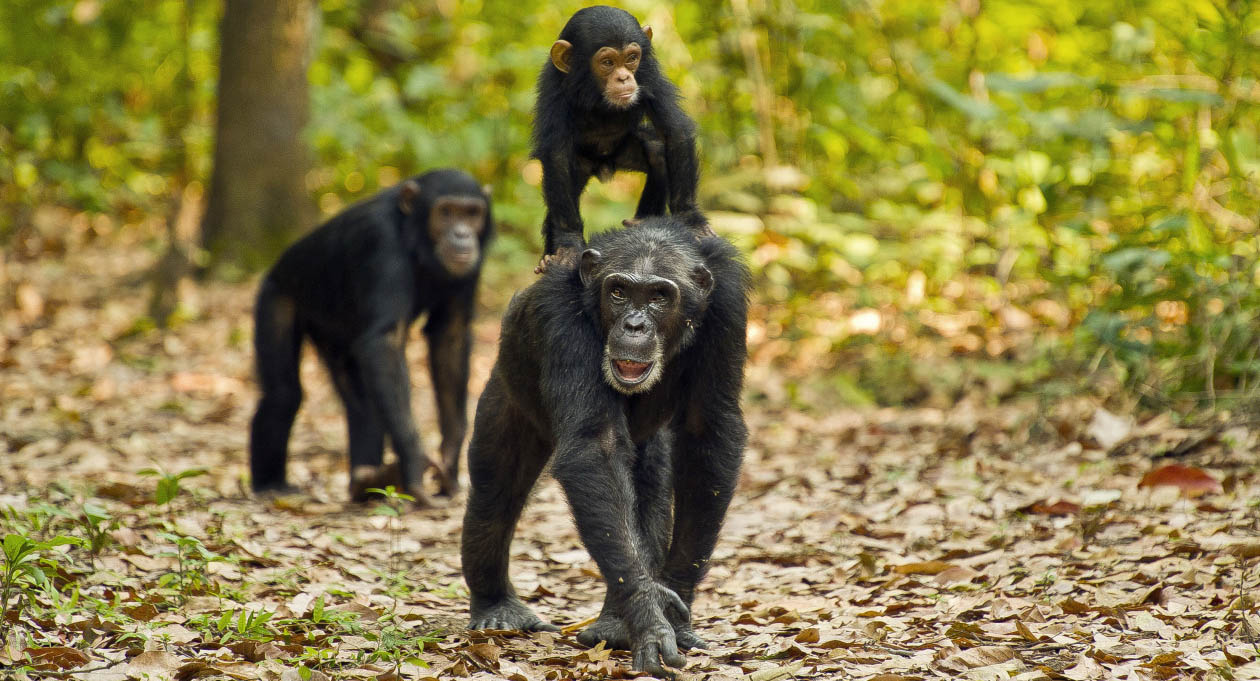
When the chimpanzees are found, the experience becomes almost surreal. You may watch them grooming each other, a sign of social bonding and trust. Mothers cradle their young with gentle care, while juveniles play energetically in the trees. A dominant male may sit quietly, observing his surroundings with an intelligence that feels deeply familiar.
What makes Gombe so special is the closeness of these encounters. The chimpanzees here are well habituated, meaning they are accustomed to human presence. This allows visitors to observe them at a respectful but intimate distance, creating moments of connection that are both emotional and thought-provoking.
Beyond Chimpanzees: A Rich Ecosystem
While chimpanzees are the primary attraction, Gombe Stream National Park is home to a variety of other wildlife. Several species of monkeys inhabit the forest, including red colobus monkeys, red-tailed monkeys, and blue monkeys. Olive baboons are also commonly seen, often foraging along the trails or near the lakeshore.
Birdlife in Gombe is diverse and vibrant, with species ranging from forest specialists to waterbirds along Lake Tanganyika. The park’s butterflies, insects, and plant life add further layers of richness to the ecosystem, rewarding those who take the time to look closely.
The lake itself is an essential part of the experience. Its clear, freshwater expanse stretches as far as the eye can see, creating a serene backdrop to the dense forest. After a day of trekking, the lakeshore offers a place of quiet reflection, where the sounds of the forest meet the gentle lapping of waves.
Getting There: A Remote Adventure
Reaching Gombe is part of what makes it so special. The journey typically begins with a flight to the town of Kigoma, located on the shores of Lake Tanganyika. From there, visitors travel by boat along the lake to reach the park.
This boat journey is not just transportation — it is an introduction to the remoteness and beauty of the region. As the forested hills of Gombe come into view, rising directly from the water, there is a sense of entering a place untouched by time.
The lack of road access helps preserve the park’s pristine nature and limits visitor numbers, ensuring that the experience remains exclusive and unspoiled.
When to Visit Gombe
Timing your visit to Gombe can significantly influence your experience. The dry season, from June to October, is generally the best time for chimpanzee trekking. During this period, trails are easier to navigate, and chimpanzees are often found at lower elevations, making them more accessible.
The wet season, from November to May, transforms the forest into a lush, green paradise. While trekking becomes more challenging due to slippery trails and thicker vegetation, the scenery is incredibly beautiful, and birdlife is at its peak. This season also offers a quieter experience, with fewer visitors in the park.
Each season brings its own character, and the choice ultimately depends on whether you prioritize ease of trekking or the richness of the landscape.
Accommodation and Atmosphere
Accommodation in Gombe Stream National Park is limited, which adds to its charm. Small lodges and tented camps are designed to blend into the environment, offering comfort without detracting from the natural setting.
The atmosphere is relaxed and personal. With fewer visitors, there is a sense of exclusivity and tranquility that is hard to find in more popular destinations. Evenings are often spent by the lake, watching the sunset paint the sky in shades of gold and orange, while the forest slowly quiets for the night.
The Enduring Legacy of Jane Goodall
The presence of Jane Goodall is still deeply felt in Gombe. Her research station continues to operate, and her work has inspired generations of scientists, conservationists, and travelers.
Visiting Gombe is, in many ways, a pilgrimage — a chance to stand where one of the most important scientific journeys began. It is a reminder of the power of observation, patience, and respect for the natural world.
Her discoveries did more than change science; they changed how humanity views its relationship with other species. In Gombe, that connection feels tangible.
A Different Kind of Safari Experience
Gombe challenges the traditional idea of a safari. There are no vast herds moving across open plains, no dramatic chases between predators and prey. Instead, there is stillness, focus, and depth.
This is a place where the smallest details matter — the sound of footsteps on forest soil, the rustle of leaves overhead, the quiet gaze of a chimpanzee observing you in return. It is an experience that invites reflection rather than spectacle.
For travelers seeking meaning rather than just movement, Gombe offers something rare. It is not about ticking off sightings, but about understanding, connection, and immersion.
Final Thoughts: Where Science Meets Soul
A journey to Gombe Stream National Park is both a wildlife adventure and a deeply human experience. It is a place where science reshaped our understanding of life, where conservation continues to protect fragile ecosystems, and where visitors can reconnect with nature in its purest form.
In a world where travel is often fast and crowded, Gombe stands apart. It is quiet, remote, and profoundly moving — a destination that leaves not just memories, but perspective.