
Serengeti Balloon Safaris: Cost, Experience and Booking Tips
A balloon safari over Serengeti National Park is one of the most refined and visually powerful safari experiences available in Africa. Unlike game drives that keep you at ground level, a balloon flight lifts you above the plains at sunrise, giving you a wide, silent, almost surreal perspective of one of the most complex wildlife ecosystems on the planet. It is not simply an activity added to a safari itinerary; it is a completely different way of interpreting the landscape, wildlife behavior, and scale of the Serengeti.
The experience combines early morning preparation, a calm but deeply atmospheric flight, and a celebratory landing breakfast in the bush. Although it is often described as a luxury experience, its appeal is not only about exclusivity. It is about perspective, timing, and access to views that are impossible to replicate from the ground.
The Early Morning Start and What Sets the Tone
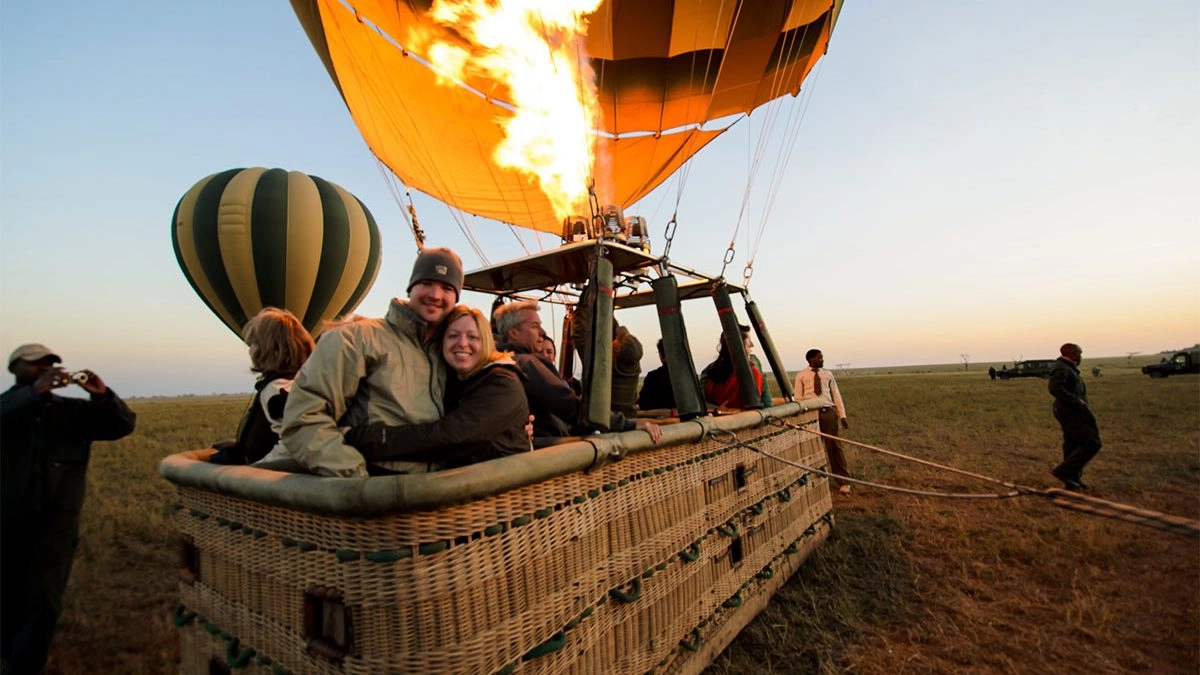
A Serengeti balloon safari begins long before sunrise. Guests are typically collected from their lodges or camps while the sky is still dark and the air is cool. This early departure is not arbitrary; it is based on wind stability and temperature conditions that are most suitable for balloon inflation and flight control.
As you are driven across the plains, the landscape is quiet and still. Night-active animals are returning to cover, while diurnal species begin to stir. This transitional period between night and day is one of the most atmospheric moments in the entire ecosystem. By the time you arrive at the launch site, you often find the balloon already being prepared, its enormous fabric slowly taking shape under the glow of burners and floodlights.
The anticipation builds as the pilot conducts a safety briefing. The instructions are straightforward but important, focusing on landing posture, basket positioning, and general safety awareness. There is no sense of rush; everything is done with calm precision, reflecting the controlled nature of balloon flight operations in wildlife environments.
Lift-Off and the Experience of Flight
The moment of lift-off is surprisingly gentle. There is no sudden acceleration or dramatic movement. Instead, the basket rises gradually as hot air fills the envelope, lifting you away from the ground almost imperceptibly. Within minutes, the sensation of altitude becomes clear as the landscape begins to expand in all directions.
One of the most striking features of ballooning over the Serengeti is silence. Once the burners are not firing, the flight is almost completely quiet. This silence allows you to absorb the environment in a way that ground safaris cannot replicate. You are not only observing wildlife but also sensing the scale of the ecosystem in its full breadth.
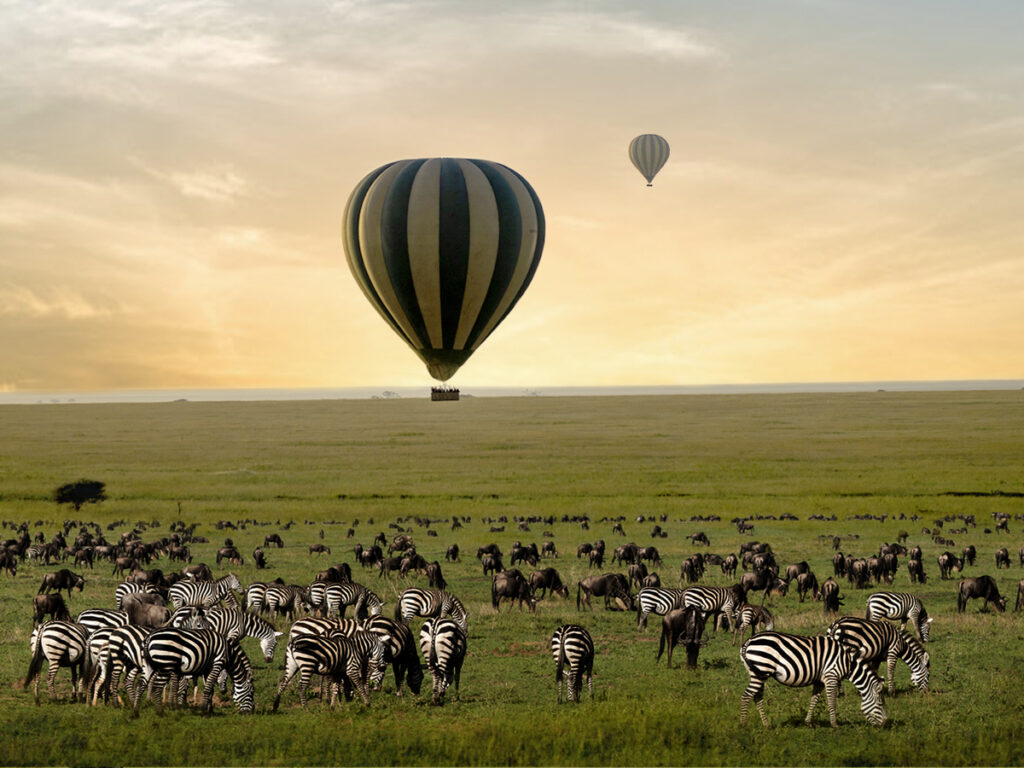
From above, the Serengeti reveals its structure. Rivers cut through grasslands like veins, acacia trees cast long morning shadows, and herds of animals appear as moving patterns rather than isolated sightings. Wildebeest migration lines, if present, stretch across the plains in fluid formations that are only fully understood from the air.
The pilot controls altitude throughout the flight, sometimes dropping low enough to observe individual animals and other times rising higher to capture panoramic views of the entire ecosystem. This variation in altitude creates a layered experience, shifting between intimate observation and wide-scale geography.
Wildlife Behavior from the Air
One of the most interesting aspects of balloon safaris is how wildlife behaves differently when observed from above. Animals are generally less disturbed by balloons than by vehicles because balloons produce minimal noise and do not approach at ground level. As a result, natural behaviors continue uninterrupted.
Elephants move slowly across open ground, giraffes browse on acacia trees, and predators such as lions often remain in resting positions during early morning hours. If the timing aligns with seasonal movement, large herds of wildebeest and zebra can be seen spreading across the plains in coordinated formations that reflect migration dynamics.
During certain times of the year, especially when the Great Migration is present in the central or northern Serengeti, the aerial view can reveal river systems, crossing points, and herd density patterns that are difficult to interpret from ground level. This makes the balloon safari not only a scenic experience but also an ecological one, offering insights into how wildlife distributes itself across landscapes.
Landing and the Bush Breakfast Tradition
After approximately one hour in the air, the balloon begins its descent. Landing is carefully managed based on wind direction and ground conditions. The basket may touch down smoothly or occasionally glide across grassland for a short distance before coming to rest.
What follows is one of the most celebrated traditions of balloon safaris: the bush breakfast. A table is set in the open savannah, often with champagne or sparkling wine, fresh fruits, pastries, eggs, and hot beverages. The contrast between the vast wilderness around you and the formal elegance of the breakfast setup creates a unique atmosphere that blends adventure with celebration.
This moment is not rushed. Travelers often spend time reflecting on the flight, taking photographs, and simply absorbing the stillness of the morning. The experience feels complete in a way that extends beyond the flight itself, creating a full narrative arc from darkness to sunrise to grounded relaxation in the wild.
Cost Structure and What Influences Pricing
The cost of a Serengeti balloon safari is typically in the range of 550 to 650 US dollars per person, although prices can vary depending on operator, season, and launch location within the park. This cost usually includes transfers from your lodge, the balloon flight itself, landing coordination, and the bush breakfast.
The pricing reflects several operational realities. Balloon systems require specialized equipment that must be maintained to high safety standards. Flights are dependent on highly trained pilots with knowledge of both aviation and local meteorological conditions. In addition, logistics in remote wilderness areas add transportation and support costs that are significantly higher than standard safari activities.
During peak safari seasons, particularly when demand is high due to the presence of the Great Migration, prices may increase slightly or availability may become limited. Luxury safari packages that combine lodges, flights, and guided safaris often integrate balloon experiences as premium inclusions, which can make the overall value more accessible when viewed as part of a full itinerary.
Seasonal Variations and Ideal Timing
Although balloon safaris operate year-round, conditions vary by season. The dry season is generally considered the most stable period for flights due to predictable winds and clearer skies. However, each season offers a different visual experience.
In the dry months, the landscape appears golden and expansive, with wildlife easier to spot due to reduced vegetation. During greener periods following rains, the plains transform into lush environments with more dispersed wildlife patterns. Both conditions offer distinct advantages depending on what a traveler wishes to experience.
If the migration is present in the region, aerial views can change dramatically depending on herd distribution and movement patterns. The unpredictability of wildlife location adds a dynamic quality to each flight, ensuring that no two balloon safaris are identical.
Photography and Visual Experience
From a photography perspective, balloon safaris offer unique challenges and opportunities. Lighting conditions at sunrise are ideal, producing soft golden tones and long shadows that enhance landscape depth. However, the movement of the balloon requires quick adaptation to shifting angles and perspectives.
Unlike ground safaris where subjects can be approached or repositioned, balloon photography is about timing and observation. Wide-angle shots capture the scale of the plains, while zoom lenses allow focus on specific herds or landscape features. The lack of vehicle vibration also provides stability, although basket movement must still be considered.
Many travelers find that the most memorable images are not just wildlife-focused but landscape-oriented, capturing the relationship between animals and their environment.
Safety and Operational Reliability
Balloon safaris in the Serengeti are operated under strict aviation and park regulations. Pilots undergo extensive training, and flights are subject to daily weather assessments. If wind conditions are not suitable, flights are delayed or cancelled rather than risk compromised safety.
Safety briefings before each flight ensure passengers understand landing procedures and basic positioning. While balloon travel is generally considered safe, it remains dependent on environmental conditions, which are taken very seriously by operators.
Booking Strategy and Travel Planning
Booking a balloon safari requires advance planning, particularly during peak travel months. Because flights are limited in number and highly dependent on weather windows, availability can become restricted. Most travelers arrange balloon safaris through their safari operator or lodge, which helps coordinate timing with their overall itinerary.
Flexibility is important. Even with confirmed bookings, flight times or dates may shift slightly due to weather conditions. Travelers who understand this adaptive scheduling tend to have a smoother experience.
Integrating a balloon safari into a broader Serengeti itinerary also enhances value. It often pairs naturally with game drives, especially when timed during migration periods or when staying in central safari zones where wildlife density is high.
Final Perspective
A Serengeti balloon safari is ultimately an experience defined by perspective. It transforms the way the landscape is understood, revealing ecological relationships, migration dynamics, and spatial scale in a single continuous view. While it is a premium activity in terms of cost, its value lies in the rarity of the viewpoint it offers.
Floating silently over one of the world’s greatest wildlife ecosystems at sunrise is not simply about seeing animals from above. It is about witnessing the Serengeti as a living system, interconnected and constantly in motion, shaped by light, weather, and migration.